

Key Takeaways
- Autonomous Execution: Unlike passive language models, AI agents for business break down high-level business goals, select dynamic tools, query APIs, and execute end-to-end operational workflows autonomously.
- Rapid Enterprise Scale: According to Gartner’s enterprise predictions, 40% of enterprise software applications will feature task-specific AI agents by 2026, marking a massive shift from simple text-generation interfaces to action-driven systems.
- Architectural Shift: Successful deployments depend on a closed Perception → Context Retrieval → Planning → Tool Calling → Reflection loop governed by strict authorization boundaries.
- Modern Unit Economics: Pricing in 2026 has rapidly shifted away from pure seat licenses toward hybrid and outcome-based pricing models, where businesses pay per resolution or workflow run.
What Is an AI Agent for Business?
An AI agent for business is an autonomous software system that uses underlying foundation models to perceive organizational data, reason through multi-step operational tasks, and call external tools to complete measurable business objectives without continuous human intervention.
Unlike traditional software scripts that rely on static if-then rules, an AI agent operates within a dynamic environment. Building on core large language model use cases, these agents do not merely return pre-drafted text when an inbound request arrives. Instead, they query backend databases, evaluate contextual parameters, select the appropriate software application (such as an ERP, CRM, or accounting ledger), and complete the end-to-end task.
Whether organizations are utilizing pre-built models or deploying custom ai agents for business, they can tailor these autonomous systems to meet their specific operational needs and integrate them seamlessly with existing ERP and CRM tools.
Key Capabilities of Enterprise AI Agents
- Autonomous Tool Execution: Directly interacting with production APIs, SQL databases, email clients, and web interfaces via standard protocols.
- Dynamic Multi-Step Planning: Decomposing complex goals into distinct milestones, tracking state across sub-tasks, and self-correcting when an execution step fails.
- Contextual Long-Term Memory: Retaining transaction histories, customer relationship records, and internal standard operating procedures (SOPs) across multi-turn interactions.
- Human-in-the-Loop Safeguards: Pausing execution when hitting financial, legal, or data-modification safety thresholds to request supervisor approval.
How Do AI Agents for Business Work? The 5-Stage Architecture
To build reliable business operations around AI agents, leaders must understand how an agent moves from raw business inputs to verified execution. Empirical research into agentic workflow integration in business process automation outlines a standard five-stage execution lifecycle:
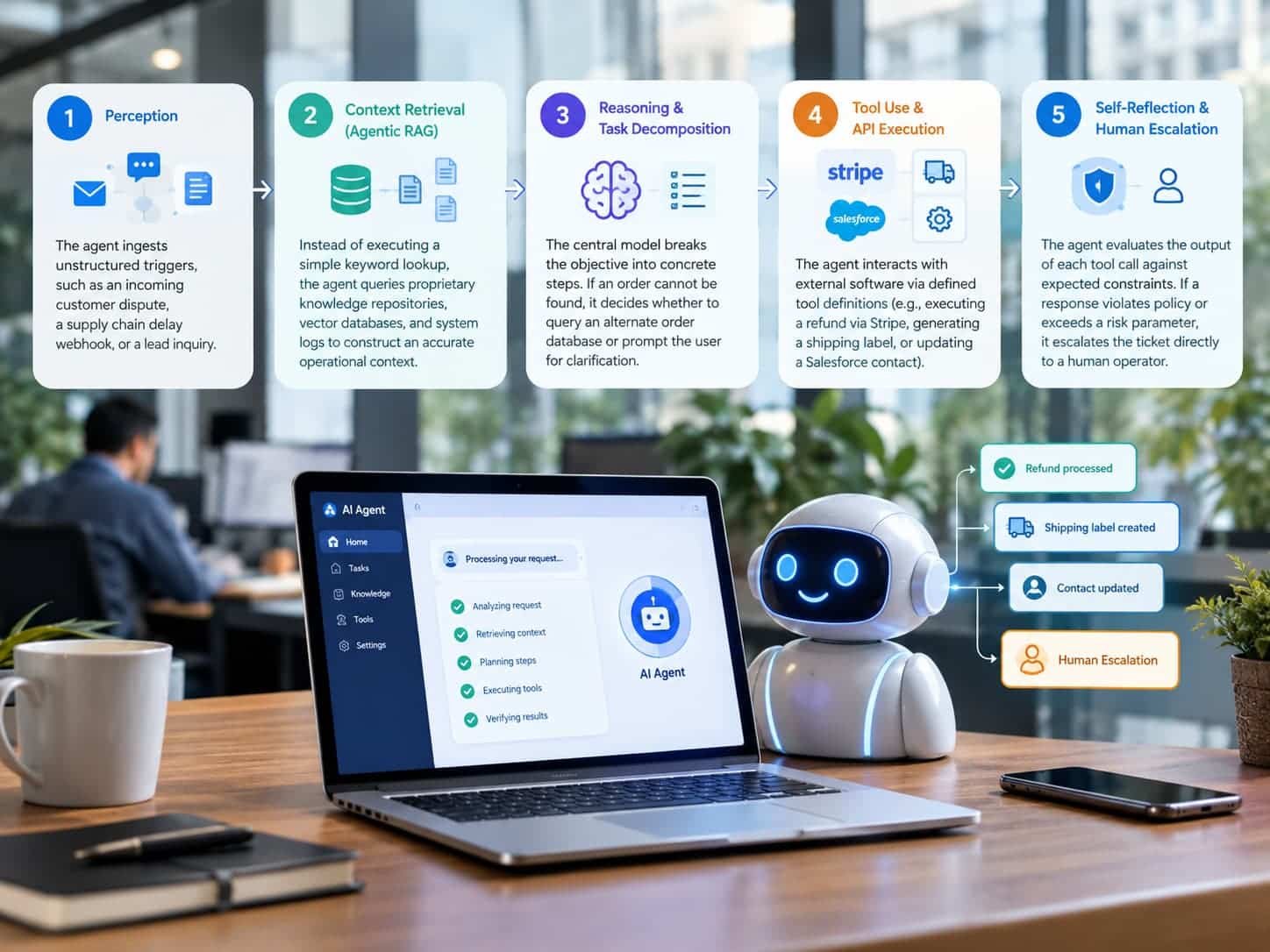
- Perception: The agent ingests unstructured triggers, such as an incoming customer dispute, a supply chain delay webhook, or a lead inquiry.
- Context Retrieval (Agentic RAG): Instead of executing a simple keyword lookup, the agent queries proprietary knowledge repositories, vector databases, and system logs to construct an accurate operational context.
- Reasoning & Task Decomposition: The central model breaks the objective into concrete steps. If an order cannot be found, it decides whether to query an alternate order database or prompt the user for clarification.
- Tool Use & API Execution: The agent interacts with external software via defined tool definitions (e.g., executing a refund via Stripe, generating a shipping label, or updating a Salesforce contact).
- Self-Reflection & Human Escalation: The agent evaluates the output of each tool call against expected constraints. If a response violates policy or exceeds a risk parameter, it escalates the ticket directly to a human operator.
Top Business Use Cases for AI Agents in 2026
Modern enterprises are no longer deploying generic chatbots for surface-level answers. Instead, they deploy specialized, domain-tailored agents across mission-critical departments.
1. Operations & Supply Chain
- Automated Inventory Balancing: Agents monitor real-time stock levels across regional distribution centers, forecasting localized demand spikes and automatically triggering vendor purchase orders within pre-set budgets.
- Invoice & Vendor Reconciliation: Cross-referencing purchase orders against scanned bills of lading and accounting ledgers, resolving fractional discrepancies and scheduling approvals.
2. Customer Support & Resolution
- End-to-End Issue Resolution: Moving beyond simple FAQ replies, a trend reflecting broader AI transformations across healthcare and enterprise operations, customer service agents authenticate accounts, process order changes, execute returns, and apply account credits directly through integration with core help desk software.
- Omnichannel Voice & Text Routing: Pairing conversational voice layers with backend execution agents to resolve tier-1 phone calls in real time.
3. Sales & Revenue Operations
- Autonomous Outbound Lead Qualification: Agents research inbound prospects across company registries, score fit against ideal customer profiles, and draft personalized outreach sequences.
- Meeting Scheduling & CRM Hygiene: Listening across email threads, negotiating meeting times directly against multiple calendars, and updating lead stages in CRMs without manual data entry.
- Content & Campaign Management: Deploying ai marketing agents for personalized outreach and utilizing an ai agent for content distribution to automatically publish, schedule, and optimize marketing materials across various digital channels.
4. Human Resources & Internal IT
- Employee Onboarding Automation: Provisioning SaaS access, generating software accounts, verifying compliance documents, and delivering tailored security walkthroughs.
- IT Service Desk Triage: An ai agent for it support can autonomously handle resetting credentials, provisioning temporary VPN tunnels, and resolving permission requests within established enterprise security policies.
AI Agents vs. AI Assistants vs. Chatbots: What Is the Difference?
A common failure in enterprise digital transformation is confusing rule-based chatbots or conversational assistants with autonomous multi-step agents. Each fulfills a distinct function along the automation spectrum:
| Dimension | Rule-Based / AI Chatbots | AI Assistants (Copilots) | Autonomous AI Agents |
| Primary Function | Conversational FAQ answering and guided navigational trees | Supporting human knowledge workers with drafting, summarization, and search | Independently executing multi-step business processes from start to finish |
| Autonomy Level | Low (strictly scripted or single-turn response) | Medium (human initiates prompt; human reviews output) | High (autonomous planning, tool selection, and execution) |
| Tool Execution | Minimal (typically limited to webhook links) | Moderate (context gathering within one host application) | Advanced (multi-system API calls, database writes, web browsing) |
| Error Handling | Hard-coded fallback (“Let me connect you to an agent”) | Relies on user re-prompting and manual correction | Built-in self-correction loops, fallback retries, and escalation policies |
| Typical Integration | Front-facing website widget | Browser extension, IDE, or office suite overlay | Deep API/database integrations across ERP, CRM, and cloud services |
When evaluating ai agents vs rpa for business automation, the primary difference lies in adaptability. While Traditional RPA (Robotic Process Automation) relies on rigid, rule-based scripts that break when interfaces change, AI agents feature dynamic planning, semantic understanding, and self-correction loops.
How to Choose the Best No-Code & Low-Code AI Agent Platforms in 2026
When evaluating no code ai agent platforms or searching for a robust low code ai agent platform to build, orchestrate, or deploy AI agents, organizations should assess candidates across four structural dimensions:
1. Tool Integration & Protocol Support
An AI agent is only as capable as the internal tools it can reach. Prioritize platforms that natively support open protocols such as the Model Context Protocol (MCP) or robust REST/GraphQL connectors. This prevents vendor lock-in and allows agents to communicate with your internal databases, spreadsheets, and custom microservices.
2. Security, Authentication, and Governance
Autonomous software requires strict boundaries. Platforms must align with established enterprise standards such as the NIST Artificial Intelligence Risk Management Framework. Look for platforms offering:
- Granular Role-Based Access Control (RBAC) and individual agent identities.
- SOC 2 Type II compliance and end-to-end data encryption.
- Deterministic guardrails that block unauthorized data exfiltration or unintended tool executions.
3. Orchestration & Human-in-the-Loop Controls
For true ai agent workflow automation, enterprise adoption requires an intuitive ai agent workflow builder with visual canvases and programmatic debugging traces. Leading multi-agent architectures such as those integrated into platforms like Droven.io allow teams to define clear escalation paths where an agent can complete 90% of a workflow but halt before financial disbursement until an administrator clicks “Approve.”
4. Model Agnosticism
Foundation models evolve rapidly. Avoid platforms tethered to a single LLM vendor. To ensure maximum efficiency alongside ongoing advancements in AI hardware development, an enterprise platform should allow your engineers to route complex reasoning tasks to high-tier models while routing high-frequency formatting tasks to faster, low-cost alternatives.
What Do AI Business Agents Cost in 2026?
When evaluating the cost of implementing ai agents for business 2025 2026, organizations will find that the pricing landscape has fundamentally shifted. Today’s agent ai cost structures have decoupled from traditional per-seat SaaS models. According to analysis on modern AI agent economics, companies typically encounter three primary billing structures:
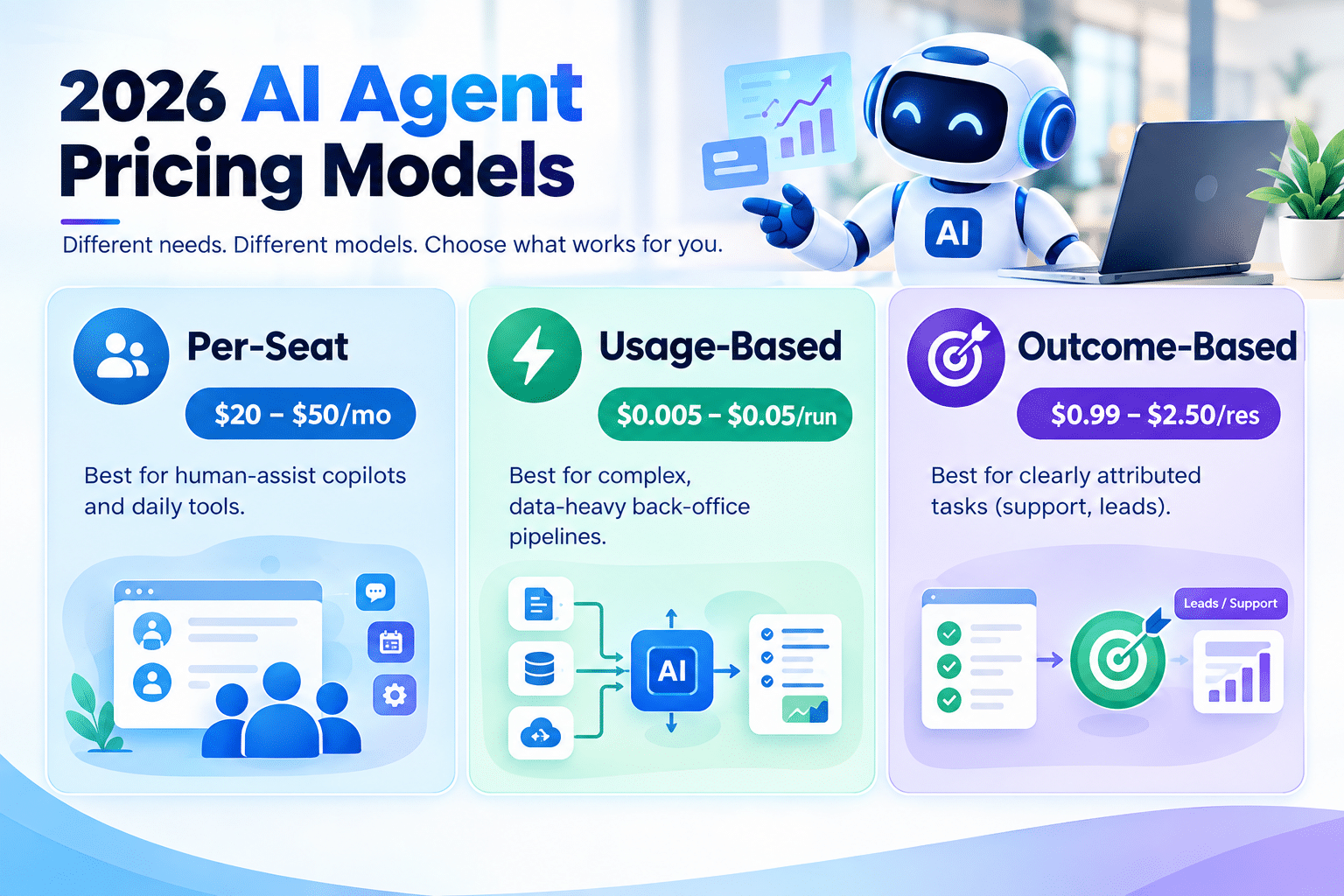
1. Hybrid Platform + Consumption Tier (Most Common)
- Base Subscription: $100 to $1,500/month covering enterprise hosting, security certifications, and connector libraries.
- Consumption Metering: Billed per execution minute, API step, or token throughput (averaging $0.01 to $0.08 per successful workflow run).
2. Outcome-Based Billing
- Common in customer service and sales automation, where platforms charge strictly for measurable results (e.g., $0.99 to $2.00 per fully resolved customer interaction, or $20 to $50 per confirmed sales meeting booked).
- This structure directly aligns costs with business value, ensuring organizations only pay when the agent eliminates manual human work.
3. Custom Internal Deployment Costs
Organizations building custom agent frameworks internally should budget for:
- Development & Tool Engineering: $15,000 to $60,000 upfront for bespoke API integrations, vector indexing, and guardrail configuration.
- Ongoing Infrastructure & Model Inference: $300 to $2,500/month depending on query volume, document indexing frequency, and chosen model sizes.
Frequently Asked Questions
Can AI agents replace human employees in 2026?
AI agents are designed to replace repetitive, multi-step operational tasks rather than entire job roles. By managing routine data extraction, system reconciliation, and high-frequency inquiries, agents eliminate administrative drag, allowing human teams to focus on relationship management, strategic decisions, and high-stakes problem-solving.
Are autonomous AI agents safe for sensitive corporate data?
When deployed using enterprise-grade architectures that adhere to frameworks like the NIST AI RMF, AI agents are secure. Enterprise platforms isolate data within private virtual clouds, implement strict API authorization limits, and prevent corporate data from being used to train public foundation models.
How long does it take to deploy an AI agent in production?
Deploying a pre-configured AI agent using low-code orchestration platforms typically takes between 1 to 3 weeks, including knowledge base indexing and sandboxed testing. Custom enterprise agent networks requiring proprietary ERP integrations and custom security approval gates generally require 6 to 12 weeks.
How do AI agents handle errors or hallucinations during execution?
Modern business agents employ reflection and validation loops. Before finalizing an API action (such as writing to a ledger), the agent checks the output parameters against system schemas and database constraints. If an error or ambiguity is encountered, the agent either retries through an alternative path or routes the execution context to a human administrator.
Leave a Reply