

Customer expectations have permanently shifted toward round-the-clock immediacy. Waiting twenty minutes in a live chat queue or twelve hours for an email response is no longer acceptable to digital buyers. According to industry operational data compiled by ChatBot.com, 77% of consumers expect immediate interaction when reaching out to support, driving 76% of modern contact centers to deploy conversational artificial intelligence.
At the same time, companies face increasing pressure to rein in operational overhead without compromising service quality. Modern ai-powered chatbots for business solve this dilemma. Rather than forcing users through rigid decision trees that break at the first typo, today’s conversational interfaces combine large language models, retrieval-augmented generation (RAG), and strict enterprise governance to deliver instant, accurate assistance across web, mobile, and messaging apps.
Key Takeaways:
- AI chatbots resolve up to 50% of routine inbound customer queries instantly, lowering support desk expenses by 30% to 70%.
- Modern conversational architectures rely on controlled grounding, querying internal vector knowledge bases rather than generating unverified responses.
- Chatbots specialize in natural dialogue and single-turn task fulfillment, while autonomous AI agents handle dynamic multi-step business orchestration.
- Successful enterprise rollouts require strict alignment with security benchmarks such as the NIST AI Risk Management Framework and the EU AI Act.
What Are AI-Powered Chatbots for Business?
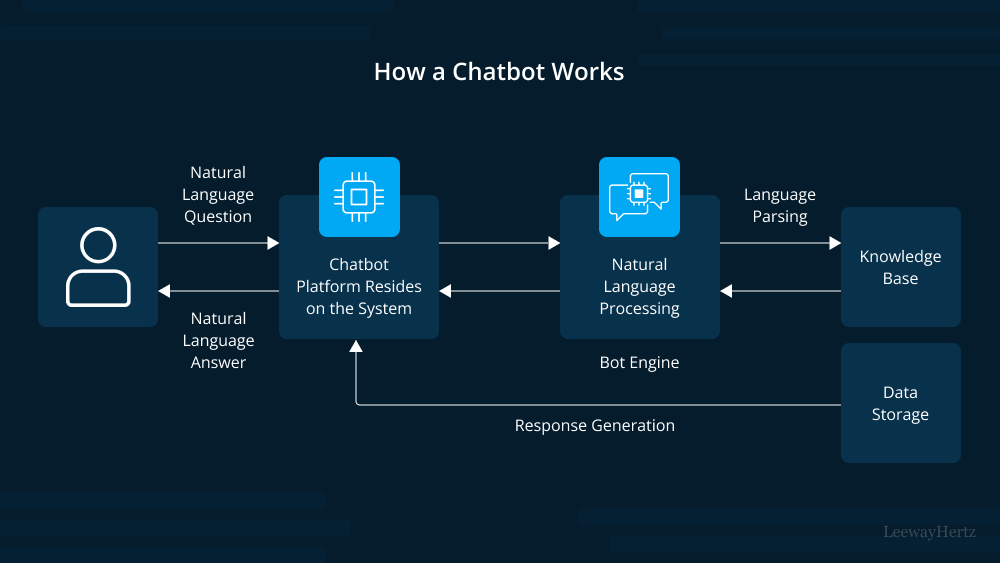
An AI-powered chatbot for business is an enterprise conversational software solution that uses natural language processing (NLP) and machine learning to understand customer inquiries, retrieve verified business knowledge, and execute contextual conversational tasks. Unlike traditional script-based bots that rely strictly on hard-coded decision paths, an AI chatbot interprets customer intent dynamically and generates human-like, accurate answers tailored to individual user needs.

Core Capabilities of Enterprise AI Chatbots
- Semantic Intent Recognition: Accurately interprets slang, misspellings, colloquial expressions, and complex sentence structures without returning error loops.
- Controlled Retrieval-Augmented Generation (RAG): Restricts answers strictly to company-approved knowledge bases, preventing model hallucinations.
- Omnichannel Deployment: Operates seamlessly across web widgets, WhatsApp, SMS, Facebook Messenger, and in-app chat windows.
- Multilingual Support: Detects customer language on the fly and replies accurately in dozens of languages without requiring localized staffing.
- Deterministic Escalation: Automatically transfers complicated queries, high-stakes complaints, or VIP accounts to human agents with full conversation summaries.
How Are Businesses Using AI Chatbots in 2026?
Enterprise applications have expanded far beyond the rudimentary FAQ widgets of previous years. Modern implementations directly impact customer acquisition, retention, and back-office efficiency.
1. 24/7 Front-Line Customer Support and Triage
High-volume support operations frequently experience ticket backlogs during seasonal peaks, product updates, or off-hours. AI chatbots act as an always-on first tier of support.
- Scenario: A software-as-a-service (SaaS) client experiences an account lockout at 2:00 AM on a weekend.
- Traditional Approach: The customer submits a ticket, waits until regular business hours on Monday, and experiences operational downtime.
- AI Chatbot Approach: The conversational bot authenticates the user, verifies identity via two-factor protocols, issues a secure password-reset link, and closes the ticket within ninety seconds.
- Business Outcome: Academic research published in the Computer Science and IT Research Journal shows that automated conversational systems dramatically decrease first-response time while driving substantial operational savings.
2. Conversational Lead Qualification and Pipeline Generation
Static web forms suffer from low conversion rates because high-intent buyers want instant answers before providing contact information.
- Scenario: A prospective B2B enterprise client visits a pricing page comparing tiered software packages.
- Traditional Approach: The prospect fills out a generic “Contact Sales” web form and waits twenty-four to forty-eight hours for a sales representative to reach out.
- AI Chatbot Approach: The chatbot initiates a personalized prompt based on the prospect’s browsing behavior, asks four qualifying criteria questions (team size, software stack, deployment timeline, budget), and immediately embeds an interactive calendar to book a discovery call.
- Business Outcome: Sales teams eliminate unqualified discovery calls while increasing lead capture efficiency on high-traffic landing pages.
3. Conversational Commerce and Personalized E-Commerce Guidance
E-commerce brands utilize conversational assistants to guide shoppers through complex catalogs, reducing cart abandonment and post-purchase anxiety.
- Scenario: An online retail customer looks for running shoes suited for flat feet and marathon road training.
- Traditional Approach: The customer navigates multiple faceted filter menus, reads disjointed customer reviews, and frequently leaves the site undecided.
- AI Chatbot Approach: The assistant conducts a brief interactive consultation, surfaces three matching products from the live catalog inventory, and offers a tailored checkout link. Furthermore, empirical findings in Administrative Sciences confirm that AI-driven conversational CRM solutions consistently optimize transaction efficiency and customer brand loyalty across digital retail environments.
- Business Outcome: Retailers see measurable uplifts in average order value (AOV) and conversion rates while decreasing pre-purchase support tickets.
What Are the Benefits of AI Chatbots for Business?
Deploying conversational automation produces measurable financial and operational returns. Rather than serving as an experimental technology, AI chatbots provide concrete efficiencies across key contact center metrics.
According to contact center research reported by ChatBot.com, automated conversational AI reduces front-line customer service operating expenses by up to 30%, while properly grounded deployments boost Customer Satisfaction (CSAT) scores by 38% to 44%.
Contact Center Performance Benchmarks
| Metric Dimension | Traditional Human-Only Support | Legacy Rule-Based Chatbot | Modern AI-Powered Chatbot |
|---|---|---|---|
| First-Contact Resolution (FCR) | 60% to 75% | 15% to 25% | 70% to 85% |
| Average First Response Time | 5 to 45 minutes | Instant (Rigid/Static) | < 3 seconds (Contextual) |
| Cost Per Routine Interaction | $15.00 to $25.00 | $1.50 to $3.00 | $0.50 to $1.20 |
| Out-of-Hours Coverage | Costly (Requires shift premiums) | Limited (FAQ loops only) | Native 24/7/365 coverage |
| Average CSAT Impact | Baseline standard | Frequently negative (-15%) | Positive lift (+38% to +44%) |
| Handling Capacity Scalability | Linear (Requires new hiring) | High (Breaks on novel input) | Elastic (Infinite concurrency) |
Key Business Advantages
- Significant Cost Containment: Academic analysis in Strategic Business Research highlights that deploying generative conversational systems decreases customer service labor expenditures, enabling support organizations to scale ticket volume without proportional headcount additions.
- Deflection of Repetitive Workloads: Up to half of inbound tickets consist of Tier-1 repetitive questions (shipping status, warranty details, cancellation steps). Automating these queries protects human agents from burnout and lets them focus on high-value escalations.
- Continuous Knowledge Improvement: Every conversational session produces searchable diagnostic data. Reviewing unassisted questions enables operations managers to identify product documentation gaps and update user guidance systematically.
How Do AI Chatbots Differ From AI Agents?
While the terms are often conflated in software marketing, AI chatbots and AI agents serve distinct architectural functions within an enterprise automation strategy.
As detailed in our comprehensive guide on AI Agents for Business, an autonomous AI agent is an event-driven system designed to break down high-level business goals, query multiple backend APIs, adapt to unexpected errors, and execute complex workflows without ongoing human prompts. In contrast, an AI-powered chatbot focuses on conversational dialogue, user context interpretation, and single-turn task fulfillment.
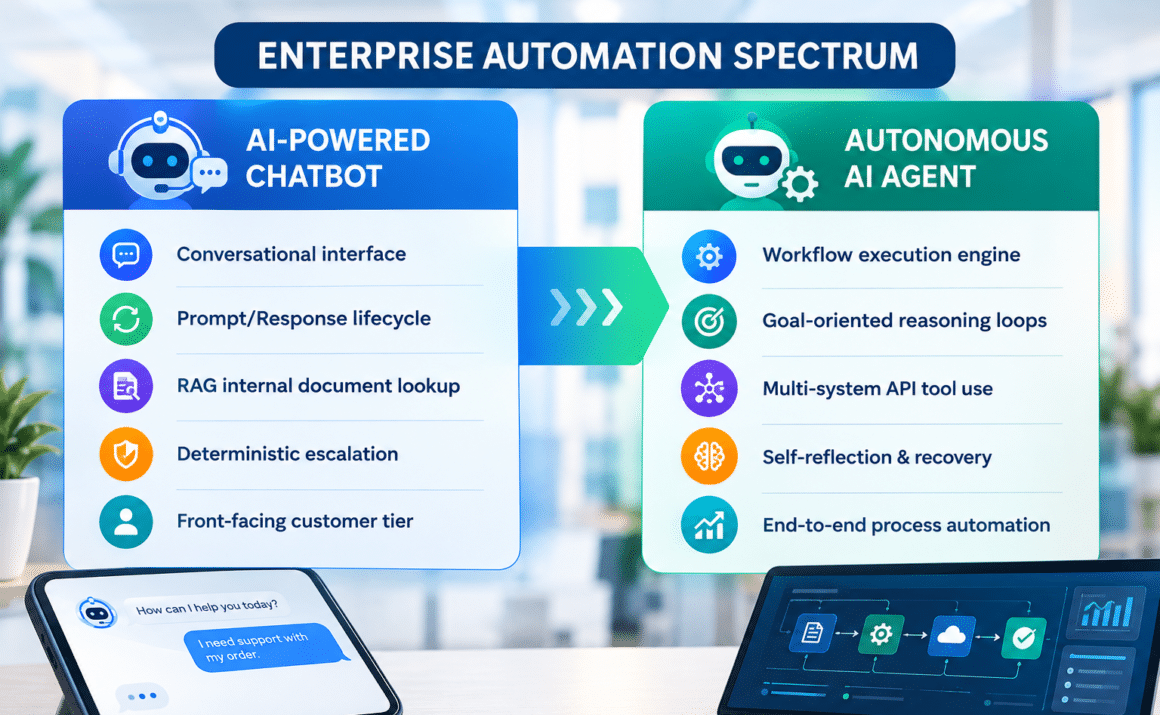
Architectural Comparison: Chatbots vs. Autonomous Agents
| Dimension | AI-Powered Chatbot | Autonomous AI Agent |
|---|---|---|
| Primary Mandate | Natural language interaction and knowledge retrieval | Autonomous execution of multi-step business objectives |
| Operational Trigger | Human conversational input (User prompt) | System webhooks, schedules, or high-level business goals |
| System Tool Access | Read-heavy (CRM lookup, knowledge bases, basic ticketing) | Read/Write across ERPs, databases, web tools, payment gateways |
| Autonomy Level | Low to Moderate (Responds within conversational parameters) | High (Formulates multi-stage execution plans independently) |
| Self-Correction | Re-prompts the user or transfers to human agent | Employs self-reflection loops to retry failed API calls |
| Deployment Layer | Front-of-house customer touchpoints | Cross-departmental operational pipelines |
Rather than choosing one over the other, mature organizations pair both technologies. The AI chatbot serves as the conversational front door, gathering user parameters and authenticating requests, while underlying enterprise AI agents perform complex back-office actions such as inventory balancing, cross-ledger accounting reconciliations, or custom database modifications.
How to Implement an AI Chatbot for Your Business: A Step-by-Step Guide
Deploying a reliable, production-grade conversational bot requires deliberate planning, rigorous content preparation, and security governance. Follow this step-by-step framework to launch effectively.
Phase 1: Scope Selection ──> Phase 2: Data Audit ──> Phase 3: Platform Selection
                                                               │
Phase 6: Iteration <── Phase 5: Guardrails <── Phase 4: Integration
Step 1: Define a Narrow, High-Impact Initial Scope
Resist the urge to build a bot that attempts to answer every operational question on day one. Successful deployments begin by isolating your highest-volume, lowest-risk query category.
- Analyze the past six months of help desk tickets in platforms such as Zendesk, Freshdesk, or Salesforce Service Cloud.
- Identify the single category representing 20% to 30% of total volume that requires factual, deterministic answers (such as order delivery status or subscription tier explanations).
- Establish baseline key performance indicators: current average handle time, cost per ticket, and resolution percentage.
Step 2: Audit and Sanitize Your Knowledge Repositories
Your conversational AI is only as dependable as the reference data it ingests. Ingestion of contradictory internal policies will lead to incorrect answers.
- Eliminate Deprecated Information: Archive outdated pricing sheets, discontinued return policies, and legacy onboarding materials.
- Normalize Knowledge Formatting: Convert fragmented email templates and unstructured documentation into clear, atomic markdown files with distinct subject headings.
- Resolve Contradictions: Ensure that return windows, warranty terms, and billing cycles are described identically across all ingested support articles.
Step 3: Select an Enterprise-Grade Conversational Platform
Select an orchestration platform that fits your technical capabilities and governance requirements.
- Prioritize platforms offering native retrieval-augmented generation (RAG) connectors that keep your data private.
- Verify that vendor contracts explicitly guarantee that your customer data will not be used to train public foundation models.
- Choose tools providing visual conversation builders alongside robust webhook support for CRM and ERP integrations.
Step 4: Configure Grounding and Enterprise Guardrails
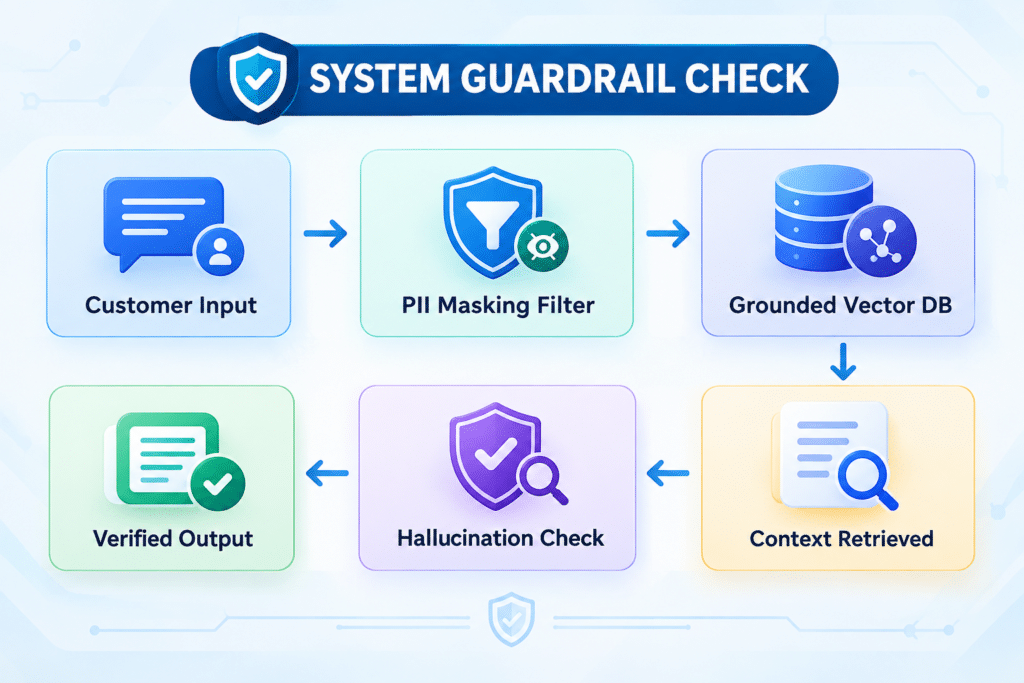
Prevent hallucinations by confining the chatbot’s generation parameters strictly to your verified knowledge base.
- System Grounding Prompt: Instruct the underlying model: “Answer customer inquiries solely using the provided documentation. If an answer cannot be verified directly from the source material, state that you do not have that information and offer to connect the user with a team member.”
- Privacy Controls: Implement automated PII (Personally Identifiable Information) masking to redact credit card numbers, passwords, and sensitive identifiers before prompts reach external model APIs, in compliance with software privacy research published by the Association for Computing Machinery.
- Regulatory Transparency: Under Article 50 of the European Union AI Act, organizations must clearly notify users whenever they are interacting with an artificial intelligence system. Display an explicit conversational disclaimer banner in your chat interface.
Step 5: Engineer Seamless Human Escalation Paths
Automation should never trap your customers in dead-end loops. If the system fails to resolve an inquiry after two turns, or if sentiment analysis detects acute frustration, route the interaction immediately.
- Map escalation triggers to specific sentiment indicators and high-risk intent keywords (such as “speak to an agent,” “legal complaint,” or “chargeback”).
- Ensure that the transfer payload includes a complete interaction summary, verified customer metadata, and conversation history so the human representative never asks the customer to repeat themselves.
Step 6: Validate with a Golden Dataset and Launch Incrementally
Before exposing your conversational system to public website visitors, run rigorous benchmark testing.
- Assemble a “Golden Dataset” of 50 to 100 historical customer inquiries representing edge cases, ambiguous phrasings, and unanswerable questions.
- Benchmark bot responses against human-verified gold answers, requiring a minimum 90% accuracy score before deployment.
- Launch the system as an internal copilot for support agents first, or roll it out to 10% of web traffic during standard business hours.
- Perform weekly transcript audits during the first sixty days to catch emergent failure modes, update knowledge gaps, and expand the bot’s scope systematically.
Best Practices for Chatbot Governance and Risk Management
Deploying conversational AI introduces regulatory, reputational, and operational considerations that require active management.
Adhere to Established Risk Management Frameworks
Modern enterprises must map AI initiatives to established standards, such as the National Institute of Standards and Technology (NIST) AI Risk Management Framework. Governance committees should audit systems across four core dimensions:
- Govern: Assign clear internal ownership of chatbot accuracy and data compliance to support operations leads rather than leaving oversight ambiguous between IT and marketing.
- Map: Document all data flows, identifying exactly where customer data travels, how long logs are retained, and which third-party APIs process requests.
- Measure: Track prompt injection vulnerability, retrieval accuracy, and abandonment rates alongside conventional business metrics.
- Manage: Maintain incident response plans for unexpected model behaviors, including one-click kill switches that instantly revert front-facing interfaces to traditional contact forms.
Measure Meaningful Quality Metrics
Avoid relying solely on “deflection rate” to evaluate chatbot performance. High deflection often disguises customer abandonment caused by unhelpful bot responses. Instead, focus on:
- True Resolution Rate: Verified via post-chat confirmation prompts (“Did this interaction resolve your inquiry today?”).
- Escalation Cleanliness: The percentage of escalations handed to human agents without context drops or technical errors.
- Segmented CSAT: Measuring customer satisfaction scores specifically on bot-handled interactions versus human-handled tickets.
Frequently Asked Questions (FAQ)
What is the difference between a rule-based chatbot and an AI-powered chatbot?
Rule-based chatbots rely on hard-coded decision trees and keyword matching. If a user enters a phrase that does not match a pre-programmed rule, the system fails. An AI-powered chatbot uses large language models and natural language processing to comprehend semantic intent, parse complex grammar, and generate dynamic, contextual answers drawn from connected corporate documentation.
Can an AI chatbot replace our human customer service team?
No. High-performing deployments treat conversational AI as operational capacity rather than human replacement. AI chatbots manage the high-volume, routine Tier-1 inquiries (such as order status checks, standard policy lookups, and basic troubleshooting), which frees human specialists to handle relationship-critical escalations, complex negotiations, and empathetic exceptions to policy.
How do modern AI chatbots prevent hallucinations?
Enterprise chatbots prevent hallucinations through Retrieval-Augmented Generation (RAG). Instead of relying on open web knowledge, the conversational model is bound strictly to your private knowledge base. When a user asks a question, the platform retrieves relevant document chunks from a vector database and instructs the language model to synthesize an answer exclusively from that verified context.
What data privacy regulations apply to business chatbots?
Organizations deploying chatbots must comply with data protection regulations such as GDPR, CCPA, and the European Union AI Act. Key requirements include informing users that they are communicating with an AI system (Article 50 EU AI Act), ensuring customer conversations are not used to train third-party foundation models without consent, and encrypting customer communication channels end to end.
How long does it take to deploy an AI chatbot in production?
Using modern low-code conversational platforms with native vector indexing, businesses can clean reference data, connect APIs, and launch a scoped Tier-1 pilot within one to three weeks. Complex enterprise deployments involving custom back-office ERP integrations, private cloud hosting, and bespoke security compliance reviews typically require six to ten weeks.
Accelerate Your Business Automation Strategy
AI-powered chatbots represent a critical first step toward building an agile, automated enterprise. By resolving repetitive inquiries instantly, containing operating expenses, and maintaining high customer satisfaction, conversational AI allows your human team to focus on high-impact strategic initiatives.
As your business workflows mature, pair your front-of-house conversational bots with backend execution engines. Explore our comprehensive architectural breakdown on AI Agents for Business to discover how autonomous multi-step software systems can orchestrate end-to-end operations across your entire organization.
Leave a Reply