
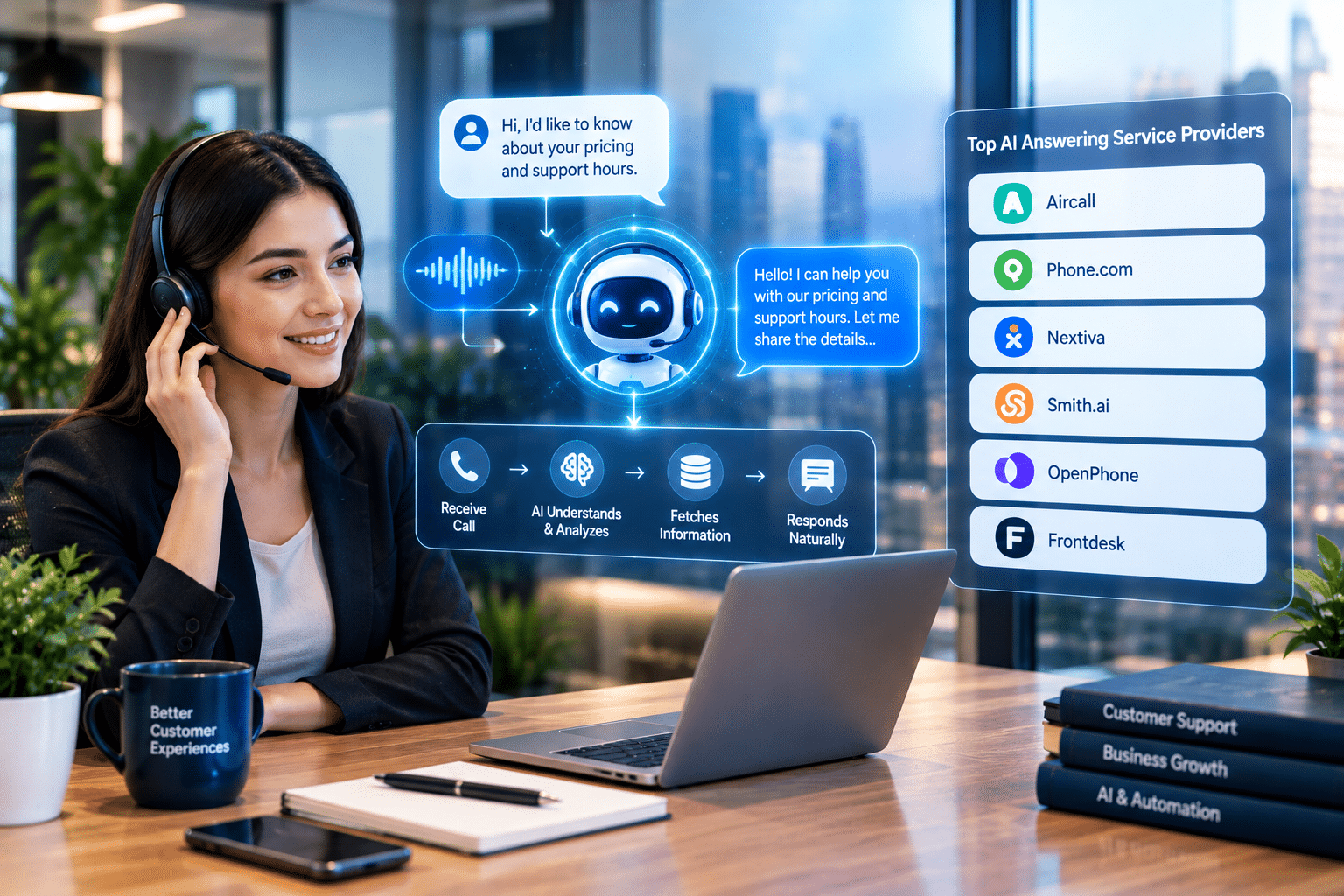
Every unanswered ring costs money. For local contractors, medical clinics, and independent firms, inbound phone calls represent immediate buyer intent, yet field studies show that over 62% of small business calls go completely unanswered. Even worse, approximately 85% of callers who encounter an unanswered line or a voicemail prompt never call back, opting instead to contact a direct competitor. Deploying a modern AI answering service permanently closes this revenue leak by answering incoming calls on the first ring, handling routine inquiries, scheduling calendar appointments, and escalating urgent matters without forcing businesses into expensive call center contracts.
Key Takeaways
- Definition: An AI answering service is an autonomous voice application that uses conversational artificial intelligence, speech-to-text models, and software integrations to conduct real-time phone conversations with callers.
- Primary Benefit: Delivers instant, 24/7 call pickup with zero hold time, capturing inbound leads and scheduling jobs while your staff focuses on core operations.
- Cost Advantage: Modern AI answering platforms typically range from $25 to $150 per month, compared to $300 to $1,500 or more per month for human-staffed call centers.
- Top Use Case: High-conversion intake, including instant appointment scheduling for clinics, dispatch triage for home services, and after-hours lead capture.
What Is an AI Answering Service for Business?
An AI answering service is an intelligent telephony solution that leverages conversational natural language processing, real-time speech synthesis, and backend system integrations to handle inbound phone calls autonomously.
It is fundamentally different from legacy voicemail and traditional interactive voice response (IVR) phone trees:
- Legacy Voicemail: A passive recording system where callers leave one-way messages. Research shows roughly 80% of callers hang up without leaving any message when redirected to voicemail.
- Traditional IVR (Touch-Tone Menus): A rigid system forcing callers through numeric menus (“Press 1 for Sales, Press 2 for Billing”) without answering custom questions or capturing nuance.
- Conversational AI Answering: An active voice agent that listens to full conversational sentences, understands caller intent in natural context, answers specific operational questions using company knowledge bases, and performs two-way actions such as booking calendars and dispatching text confirmations.
How Does an AI Answering Service Work?
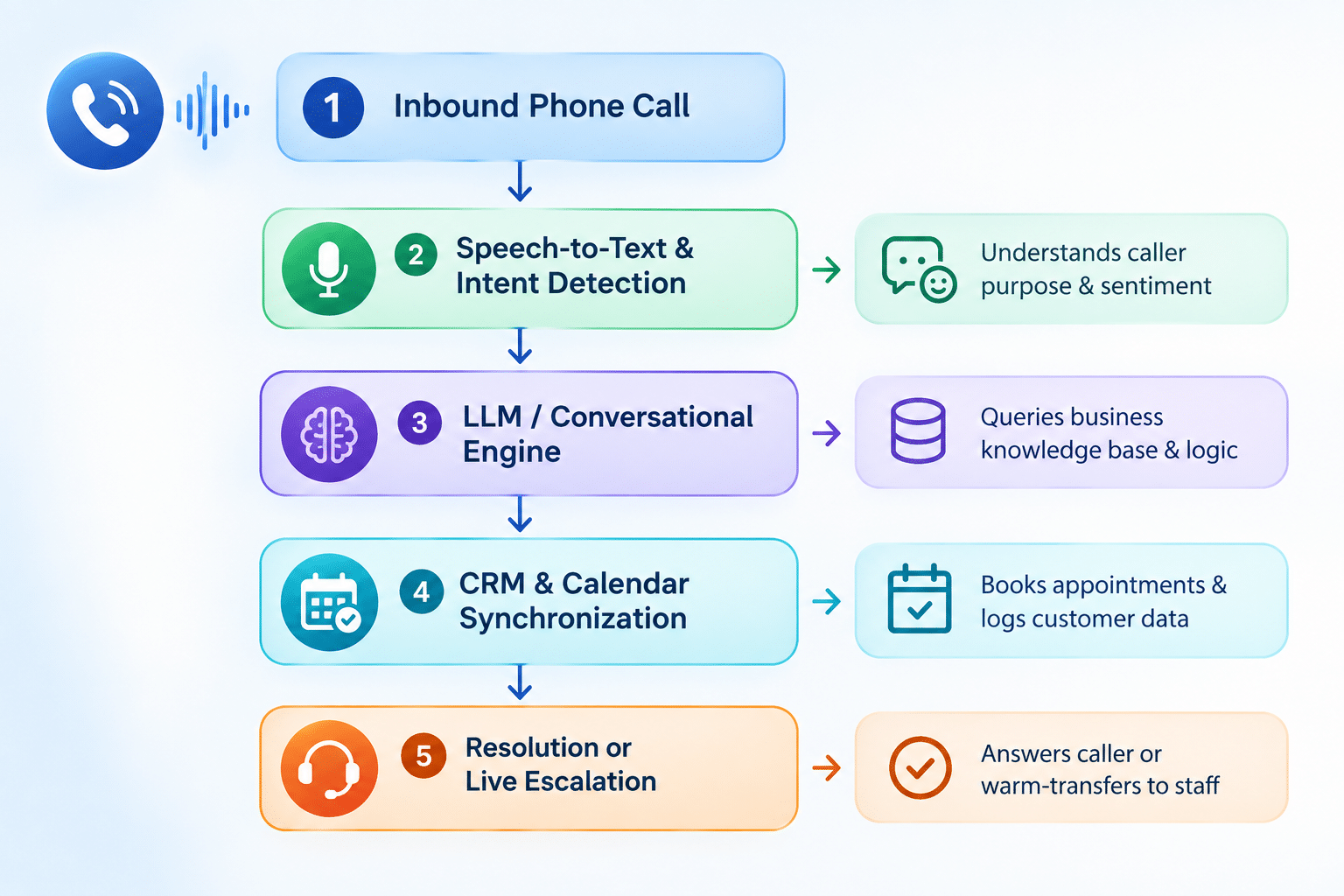
Rather than reading canned audio files, an AI answering service processes phone calls through four synchronized architectural steps:
1. Call Routing and Intent Detection
When a customer dials your business number, the system answers instantly over SIP or VoIP. Modern voice models convert caller audio into text with sub-second latency, analyzing the exact intent behind phrases like “My water heater is leaking all over the basement” versus “I want to check your office hours tomorrow.”
2. NLP-Based Natural Conversation
The system queries an underlying language model configured with your specific business parameters, pricing structures, and service areas. It responds using natural, low-latency voice synthesis that matches standard human cadence, pauses appropriately, and clarifies ambiguous statements.
3. CRM and Calendar Synchronization
During the call, the AI reads available slots directly from scheduling tools such as Google Calendar, Calendly, or industry CRMs. When the caller selects a time, the agent records their name, phone number, and issue, writing the appointment directly into your system and sending an instant SMS confirmation to the caller.
4. Live-Transfer Escalation Logic
If a caller presents an emergency, exhibits clear frustration, or requires executive discretion, the AI initiates a warm transfer. Guided by standards such as the NIST AI Risk Management Framework, the platform summarizes the caller’s initial answers and passes both the live audio and the digital transcript to an on-call team member so the customer never has to repeat themselves.
AI Answering Service vs. Traditional Answering Service (Human)
Small business owners often weigh software automation against outsourced human virtual receptionists. Below is an operational comparison of both approaches:
| Operational Dimension | AI Answering Service | Traditional Human Answering Service |
|---|---|---|
| Starting Cost | $25 to $150 per month | $300 to $600 per month (plus setup fees) |
| Billing Model | Flat per-call or low per-minute rate | Per-minute billing (often rounded up) |
| Simultaneous Capacity | Unlimited concurrent calls | Limited by operator pool size (causes hold times) |
| Availability | True 24/7/365 coverage with zero delay | 24/7 coverage (often higher rates on weekends/holidays) |
| Consistency | 100% adherence to scripts and facts | Dependent on agent mood, training, and turnover |
| System Integration | Real-time two-way CRM and calendar sync | Often limited to basic email or message dispatching |
| Complex Empathy | High conversational flow, limited deep judgment | Genuine human emotional sensitivity |

For routine bookings, after-hours triage, and repetitive inquiries, AI delivers substantial operational savings while eliminating missed calls during midday volume spikes.
AI Answering Service vs. AI Chatbot: What Is the Difference?
While both tools leverage large language models and natural language processing, their communication channel dictates their technical requirements:
- AI Answering Services (Voice): Built specifically for telephone channels. They require ultra-low latency voice engines (under 600 milliseconds), speech-to-text conversion, telephony protocol compatibility (VoIP/SIP), and specialized handling for acoustic background noise and verbal interruptions.
- AI Chatbots (Text): Deployed on websites, messaging apps, and social platforms. They rely entirely on written inputs and can deliver visual links, UI carousels, and rich media buttons.
For a deeper dive into website text automation, explore our complete analysis on AI-Powered Chatbots for Business and how digital text agents streamline online customer journeys.
Top Use Cases for an AI Answering Service
Deploying voice automation solves distinct operational bottlenecks across diverse business environments:
1. Appointment Booking for Medical Clinics and Salons
Medical practices, dental offices, and wellness salons often lose booking opportunities when desk staff are checking in physical patients. An AI answering service checks provider availability in real time, books appointments into practice management tools, and gathers patient intake details conversationally over the phone.
2. 24/7 After-Hours Emergency Triage
Emergency plumbers, electricians, and HVAC contractors receive high-value emergency calls outside standard hours. An AI voice assistant answers overnight calls immediately, screens for true emergency criteria, collects job addresses, and routes urgent jobs directly to the on-call technician’s cell phone while scheduling non-urgent inquiries for the next morning.
3. Lead Capture for Professional Services
Legal firms, accounting practices, and financial consultants often spend marketing dollars on ads that generate phone inquiries. As detailed in our breakdown of practical large language model use cases, automating initial lead qualification ensures every marketing lead is screened against firm criteria before an attorney or consultant spends time on a discovery consultation.
4. Real-Time Order and Service Status Inquiries
Logistics providers, automotive repair shops, and local retailers often deal with repetitive calls asking, “Is my car ready?” or “What are your holiday hours?” Connected directly to internal tracking software, the AI verifies caller identification and reports status updates instantly, deflecting up to 70% of repetitive front-desk call load.
Top AI Answering Services for Small Business in 2026
Choosing the right platform depends on your existing phone infrastructure, required integrations, and whether you require an optional human safety net.
1. Smith.ai (Best Hybrid AI-Plus-Human Platform)
Smith.ai offers a flexible path for growing businesses by providing both self-serve AI voice answering and access to live, professional backup receptionists on the same software stack.
- Pricing: AI answering plans start with an entry tier at $0 per month (25 included calls, $3 per-call overage) up to $150 per month for Pro tiers; human receptionist packages start around $300 per month.
- Key Features: Native CRM syncing, live call transfers, calendar booking, and automated spam blocking.
- Best For: Law firms, medical clinics, and established SMBs that want an AI-first front desk with the option to escalate complex calls to human operators.
2. Retell AI (Best for Custom Workflows and High Scalability)
Retell AI provides an infrastructure-first voice agent platform trusted by thousands of businesses handling tens of millions of monthly voice minutes.
- Pricing: Pay-as-you-go pricing ranging from $0.07 to $0.31 per minute with no restrictive long-term commitments.
- Key Features: Natural conversational latency, 20+ concurrent calls standard, automated legacy IVR navigation, and self-service HIPAA compliance configurations.
- Best For: Businesses with variable call spikes, multi-location clinics, and technical teams wanting deep workflow customization.
3. AIRA (Best Dedicated Small-Business Receptionist)
AIRA is an AI-native phone receptionist engineered specifically for small enterprises tired of unpredictable per-minute overages.
- Pricing: Predictable per-call packages starting at $24.95 per month for 30 calls, scaling up to an Enterprise flat rate for high volumes.
- Key Features: Instant pickup with zero hold time, automated language translation supporting 31 languages, and calendar synchronization with HubSpot and Google Calendar.
- Best For: Small business owners who receive calls in multiple languages and want flat, predictable monthly telephone bills.
4. Dialzara (Best Budget-Friendly Voice Starter)
Dialzara delivers one of the lowest entry barriers in the voice automation space, enabling single-operator businesses to deploy an automated assistant in minutes.
- Pricing: Starts at $29 per month for 60 minutes, scaling to $99 per month for 220 minutes.
- Key Features: Interactive appointment scheduling, lead qualification, call routing, and web chat bundling.
- Best For: Solopreneurs, trade contractors, and freelance operators seeking an inexpensive way to eliminate missed calls.
(Note on Droven.io: While Droven.io provides educational overviews and software analysis, it does not currently offer an autonomous inbound business telephone answering service product, making dedicated telephony platforms like those listed above the appropriate operational choice.)
How to Set Up an AI Answering Service for Your Business
Implementing an automated voice assistant does not require complex telecom hardware. Follow this structured five-step roadmap:
Step 1: Map Your Top 10 Recurring Call Inquiries
Review call logs from the past 60 days. Identify the ten questions and tasks that your staff handles most frequently, such as business operating hours, base pricing estimates, appointment booking steps, and cancellation requests. This becomes your knowledge base blueprint.
Step 2: Choose a Provider Compatible with Your Phone System
Select an answering provider that integrates with your existing telecom carrier (whether you use VoIP providers like RingCentral, Nextiva, or traditional landlines). Confirm that the service supports conditional call forwarding (busy/unanswered) and native calendar integrations.
Step 3: Write and Approve Clear Guardrails and Escalation Rules
Define your assistant’s conversational tone, business identity, and escalation thresholds. Configure mandatory transfer parameters:
- The caller explicitly requests a human manager
- The inquiry involves an emergency or safety hazard
- The conversation context cannot be resolved after two clarifying questions
Step 4: Test with a Soft-Launch on a Secondary Line
Before routing your primary public phone number, test the assistant on an internal test number or an after-hours schedule. Have employees, family members, and trusted clients call with messy, real-world questions, background noise, and varied accents to ensure the system responds reliably.
Step 5: Monitor Call Transcripts Weekly for the First Month
Review incoming call transcripts and audio logs every week during your initial launch. Identify questions that triggered awkward transfers or confused the AI, then add those answers into your system knowledge base to improve resolution rates over time.
Frequently Asked Questions
Can an AI answering service sound natural to callers?
Yes. Modern voice engines in 2026 operate with sub-second response latency, dynamic breathing pauses, and natural intonation. While callers generally recognize they are interacting with an efficient automated system, the conversation flows smoothly without the robotic delays associated with older systems.
Will an AI answering service replace my receptionist entirely?
No. An AI answering service is designed to eliminate repetitive administrative tasks rather than eliminate staff. By answering basic FAQs, filtering sales spam, and booking routine appointments, the AI frees your in-house receptionist to focus on in-person visitors, complex client matters, and revenue-generating projects.
How much does an AI answering service cost compared to a human service?
AI answering services generally cost between $25 and $150 per month for typical small business usage. In contrast, outsourced human call centers typically charge between $300 and $700 per month for basic minute allotments, with significant overage fees for high call volumes.
Does an AI answering service work with my existing business phone number?
Yes. You do not need to change your published telephone number. AI answering services utilize standard conditional call forwarding through your existing phone carrier. You can configure your phone to forward calls to the AI only when your line is busy, after hours, or after three unanswered rings.
Final Thoughts: Protecting Inbound Revenue
Every telephone ring represents a prospective customer reaching out at their moment of highest purchase intent. Letting those calls slip into unanswered voicemail boxes costs small businesses thousands of dollars in lost contracts and damages local reputations.
By integrating a dedicated AI answering service into your operations, you ensure that every caller receives an instant, professional response, protecting your pipeline while giving your team the focus they need to run your business.
Leave a Reply