
Quick answer: The biggest barrier to healthcare AI in 2026 is not model quality. It is data architecture. Cloudera’s 2026 research found that 95% of enterprises delayed or canceled AI projects in the previous year because of data governance, compliance, or regulatory issues, and 72% say their data architecture needs a significant overhaul. In healthcare, the problem is sharper: organizations can see their data but cannot reliably use it for AI.
The contradiction sitting at the center of healthcare AI
Here is the finding that should reframe how health systems think about their AI programs.
In healthcare findings released in July 2026 from Cloudera’s Data Readiness Index 2026, 87% of healthcare respondents reported having visibility into where their data resides. That is a high number. On paper, it suggests the hard part is solved: these organizations know what they have and where it lives.
Yet the same research found that these organizations continue to face real difficulty integrating, governing, and operationalizing trusted data at scale. Twenty-eight percent said infrastructure performance consistently hinders operational initiatives.
Visibility without usability. Health systems have spent a decade and enormous budgets building data inventories, catalogs, and governance committees, yet they have arrived at a point where they can tell you exactly which system holds the data an AI model needs and still cannot get that data to the model in a form that is governed, performant, and legally defensible.
That is not simply a data problem. It is an architecture problem, and it is one reason AI pilots in healthcare keep dying somewhere between the demo and deployment.
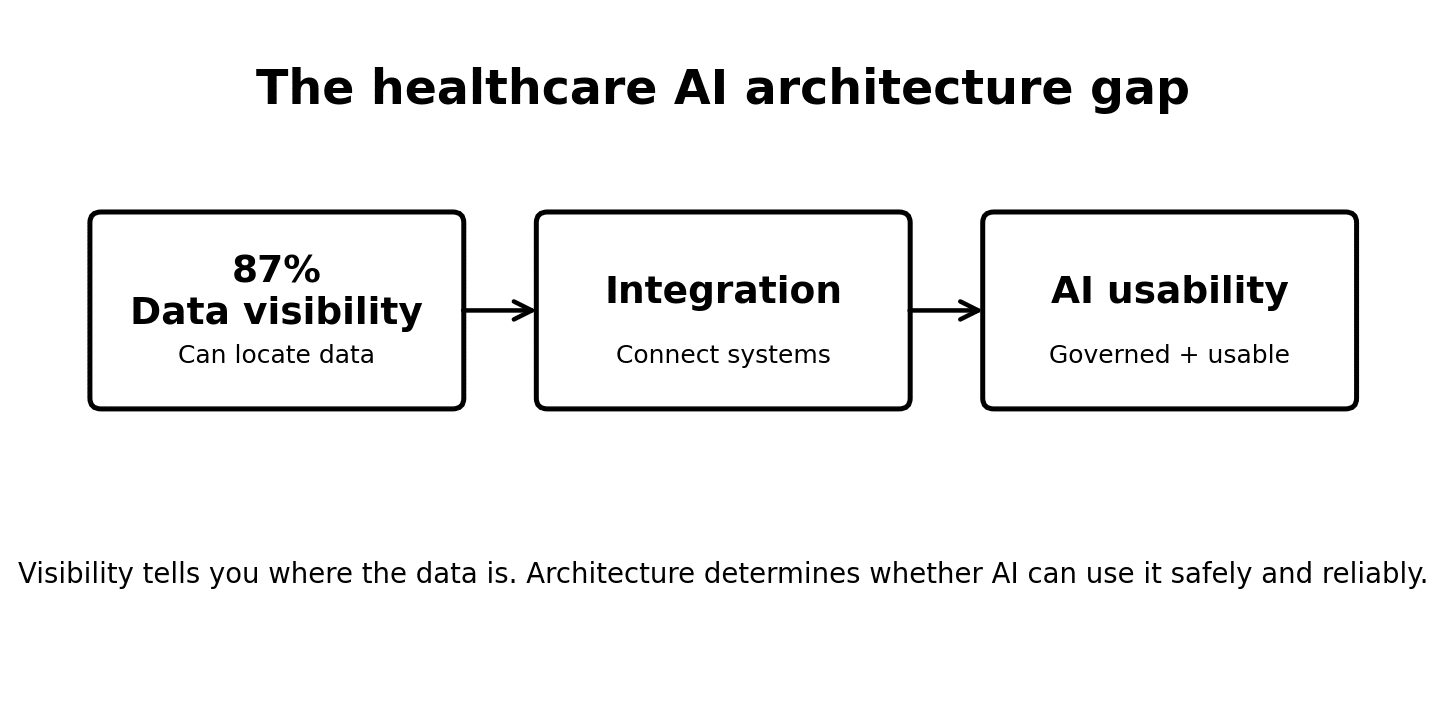
Visual: The central gap is not simply data visibility, but the ability to use data safely and reliably for AI.
The scale of the stall: what the 2026 data shows
The healthcare picture sits inside a broader enterprise pattern, and the cross-industry numbers are stark.
Cloudera’s The Great AI Re-Architecture, published in August 2026, surveyed 1,500 enterprise architects, cloud infrastructure leads, and data architects across nine markets. Wakefield Research fielded the survey in June 2026. Its headline findings:
- 77% of organizations are actively using AI in some form
- 95% delayed or canceled AI initiatives in the previous twelve months due to data governance, compliance, or regulatory issues
- 55% delayed or canceled more than six projects in that same window
- 72% say their current data architecture requires a significant overhaul to meet future AI requirements
- 75% have already moderately or significantly changed their data storage and architecture practices
- 84% report that AI workloads have increased infrastructure costs
- 42% point to data security, governance, and compliance as the driver behind those architecture changes
Read the 95% and 55% together. This is not a handful of stalled pilots. More than half of the surveyed organizations killed or delayed six or more AI projects in a single year for governance reasons, not technical failure. That is a systemic bottleneck, and it is expensive.
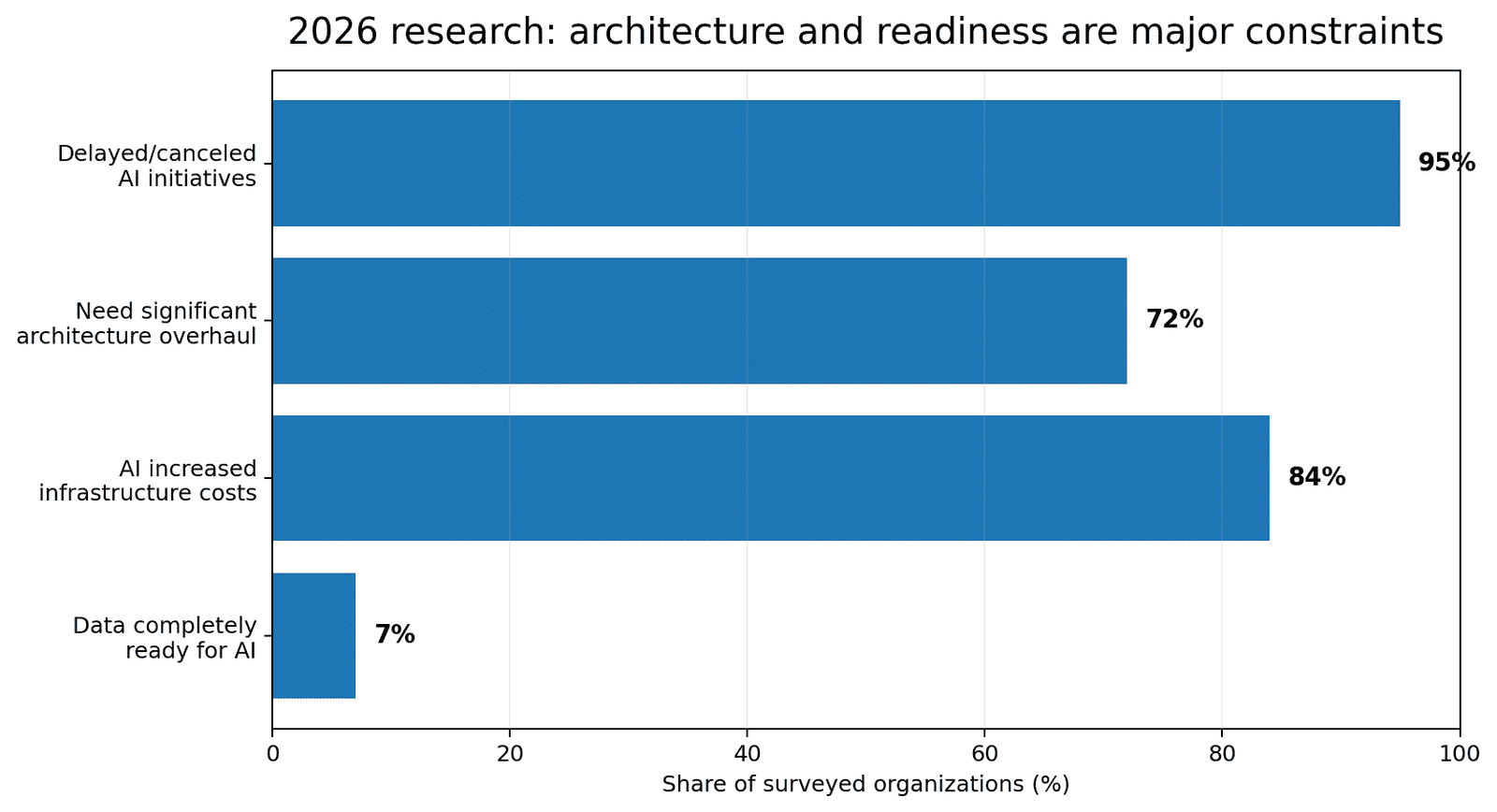
Visual: Key 2026 research figures cited in the article.
A separate study conducted for Cloudera by Harvard Business Review Analytic Services found the underlying readiness gap directly: only 7% of organizations said their data was completely ready for AI adoption, while 27% described it as not very or not at all ready. Seventy-three percent said their organization should prioritize AI data quality more than it currently does.
Cloudera CTO Sergio Gago framed the root cause plainly: architectures built for traditional analytics were never designed for the scale, governance, and flexibility that AI demands today.
Why the analytics-era stack breaks under AI
The distinction between analytics workloads and AI workloads does a lot of work here, and it is worth unpacking.
A traditional analytics architecture assumes known questions on a schedule: the nightly batch, the quarterly quality report, and the dashboard that refreshes at 6 a.m. Its governance model is built around a small set of predictable consumers accessing curated, pre-approved datasets. Access reviews happen quarterly because access patterns barely change.
AI workloads violate every one of those assumptions:
| Assumption | Analytics era | AI era |
| Access pattern | Narrow, predictable, scheduled | Broad, exploratory, continuous |
| Data scope | Curated warehouse tables | Everything, including unstructured |
| Latency | Batch, hours to days | Real time or near it |
| Governance cadence | Periodic review | Continuous enforcement |
| Output | A report | New data assets needing their own lineage |
You cannot simply bolt those requirements onto a warehouse designed in 2016 and expect the compliance team to sign off. The 72% who say they need a significant overhaul are describing exactly this mismatch.
Why healthcare is the hardest version of this problem
Now apply all of the above inside a health system, payer, or medtech firm. Four factors compound the challenge.
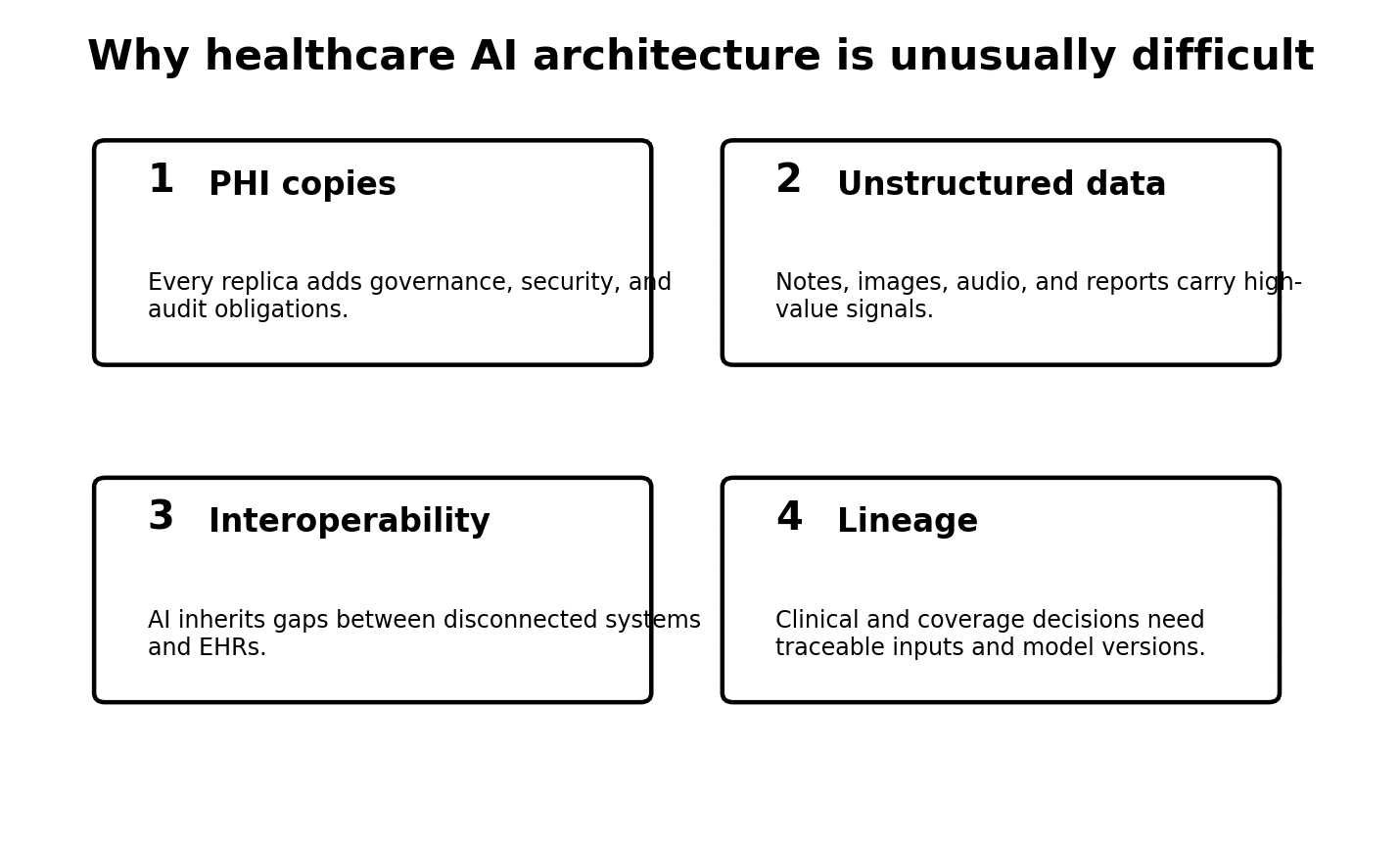
Visual: Four architectural constraints that compound in healthcare environments.
1. Every data copy is a compliance liability
Protected health information carries obligations that do not pause because a model needs training data. Every replica created to feed an AI pipeline is another asset that must be inventoried, encrypted, access-controlled, logged, and defended in an audit.
The “just copy it into the AI environment” shortcut that works in retail is a risk event in healthcare. The stakes are also quantified: as widely reported from IBM’s 2025 Cost of a Data Breach research, the average healthcare breach cost roughly $7.42 million and took around 279 days to contain, the highest of any sector for the eighth-plus consecutive year. Each unnecessary PHI replica widens that blast radius.
Cloudera’s Rameez Chatni made the architectural implication explicit: consolidating large volumes of regulated healthcare data into a single public cloud environment is frequently impractical, costly, and difficult to govern.
Worked example. A radiology group wants an AI triage tool to flag urgent findings. The fast path is to export a rolling window of studies into the vendor’s cloud environment for the model to read. That single decision creates a new PHI store outside the hospital’s existing access controls. It now needs its own encryption review, audit trail, and breach-notification exposure before the model has flagged a single case. The governed alternative is to run the vendor’s inference container inside the health system’s existing environment, reading studies in place through an API, so no image leaves the governed perimeter. The clinical outcome can be the same, with one-tenth of the compliance surface.
Pro tip: Before any AI vendor conversation, ask, “Does this require a new copy of PHI, or can it run against data in place?” That single question can eliminate a large share of unworkable proposals before they reach legal review.
2. The most valuable data is the least structured
The signal clinicians actually want lives outside tidy tables: clinical notes, discharge summaries, imaging, pathology reports, device telemetry, and ambient audio. It is precisely the data that analytics-era architecture handles worst and precisely the data with the strictest handling rules.
Every high-value healthcare AI use case depends on it: ambient clinical documentation, prior-authorization automation, imaging triage, risk stratification, and clinical trial matching. If unstructured data sits in a less-governed store outside the main perimeter, every one of those projects can be blocked in review, correctly.
Worked example. A health system rolls out an ambient scribe tool that listens to visits and drafts notes. The pilot succeeds with ten physicians in a controlled unit. Scaling to 500 physicians means the audio and derived transcripts, now classified as PHI in a form the organization has never systematically governed, flow across dozens of specialties and EHR configurations. Without a plan for where that unstructured data lives and who can query it, the rollout can stall in privacy review for months, not because the tool failed, but because governance was designed for tables, not transcripts.
Pro tip: Classify and tag unstructured data sources, including notes, audio, and images, as PHI-bearing before a pilot, not after it succeeds. Retrofitting governance onto a rollout that is already scaling is far more disruptive than building it in from pilot day one.
3. Interoperability is still unfinished business
This is the part vendor research tends to skip. Health systems are not starting from a clean baseline. Per ONC data widely cited in industry analysis, only around 43% of U.S. hospitals routinely engage in all four domains of interoperability: send, receive, find, and integrate. TEFCA and information-blocking enforcement under the 21st Century Cures Act are raising expectations for FHIR-based exchange faster than most architectures are evolving.
An AI strategy layered on top of partial interoperability inherits every gap underneath it.
Pro tip: Before greenlighting an AI project, ask which of the four interoperability domains, send, receive, find, and integrate, it depends on. A risk-stratification model that needs to find records across affiliated but separate EHR instances can fail silently, returning incomplete patient views, if that domain is not mature yet. Map the dependency before you scope the project, not after the model underperforms.
4. Explainability is a regulatory requirement, not a feature
If a model influences a clinical or coverage decision, someone will eventually ask what data it saw, which version it used, and why. Without lineage built into the architecture, that question has no answer, and “we don’t know” is an extremely expensive sentence in a healthcare audit.
Worked example. A payer’s AI model recommends denying a prior-authorization request. The member appeals. Six months later, a regulator asks exactly which claims history, clinical notes, and model version informed that specific decision. An organization with system-level lineage can answer in an afternoon by pulling the logged inputs and model version tied to that decision ID. An organization without it can spend weeks trying to reconstruct the answer from memory and scattered logs, and may not be able to reconstruct it credibly at all.
The Health Sector Coordinating Council’s Cybersecurity Working Group released guidance in June 2026 on cyber governance frameworks for secure AI implementation, addressing AI-specific risks including data poisoning, model drift, and adversarial attacks across traditional ML, generative AI, and agentic systems. Those risks are only auditable if lineage exists at the infrastructure layer.
Adoption is not the finish line: the sustained-use problem
One finding deserves more attention than it has received. Research from Duke University Health System, reported by Healthcare IT News in June 2026, found that many AI-enabled clinical decision-support tools see usage decline after initial uptake. The variable separating tools that sustain adoption from those that fade is whether care teams can directly see and validate the benefit.
This has a direct architectural implication that most procurement processes miss. A tool that clinicians adopt at launch and abandon within six months produces no efficiency or ROI, but it still consumed governance review, integration work, and infrastructure spend.
Validation requires data. Specifically, it requires the ability to measure a tool’s effect on real outcomes continuously across systems. If your architecture cannot produce that feedback loop, you cannot prove value, and without proof, clinical trust erodes and usage declines. Architecture determines not just whether you can deploy AI, but whether deployments survive.
Pro tip: Build the measurement dashboard before the clinical pilot launches, not after adoption starts slipping. If clinicians cannot see the tool’s impact on their own workload in the first few weeks, you are already on the decay curve researchers observed at Duke.
Where your organization sits: a quick maturity check
Researchers publishing in npj Digital Medicine in 2026 reviewed 35 published healthcare AI governance frameworks and distilled them into a five-level maturity model, the Healthcare AI Governance Readiness Assessment (HAIRA), spanning seven governance domains from data and infrastructure to accountability and monitoring. It is worth borrowing the level structure as a gut check, even without running the full assessment:
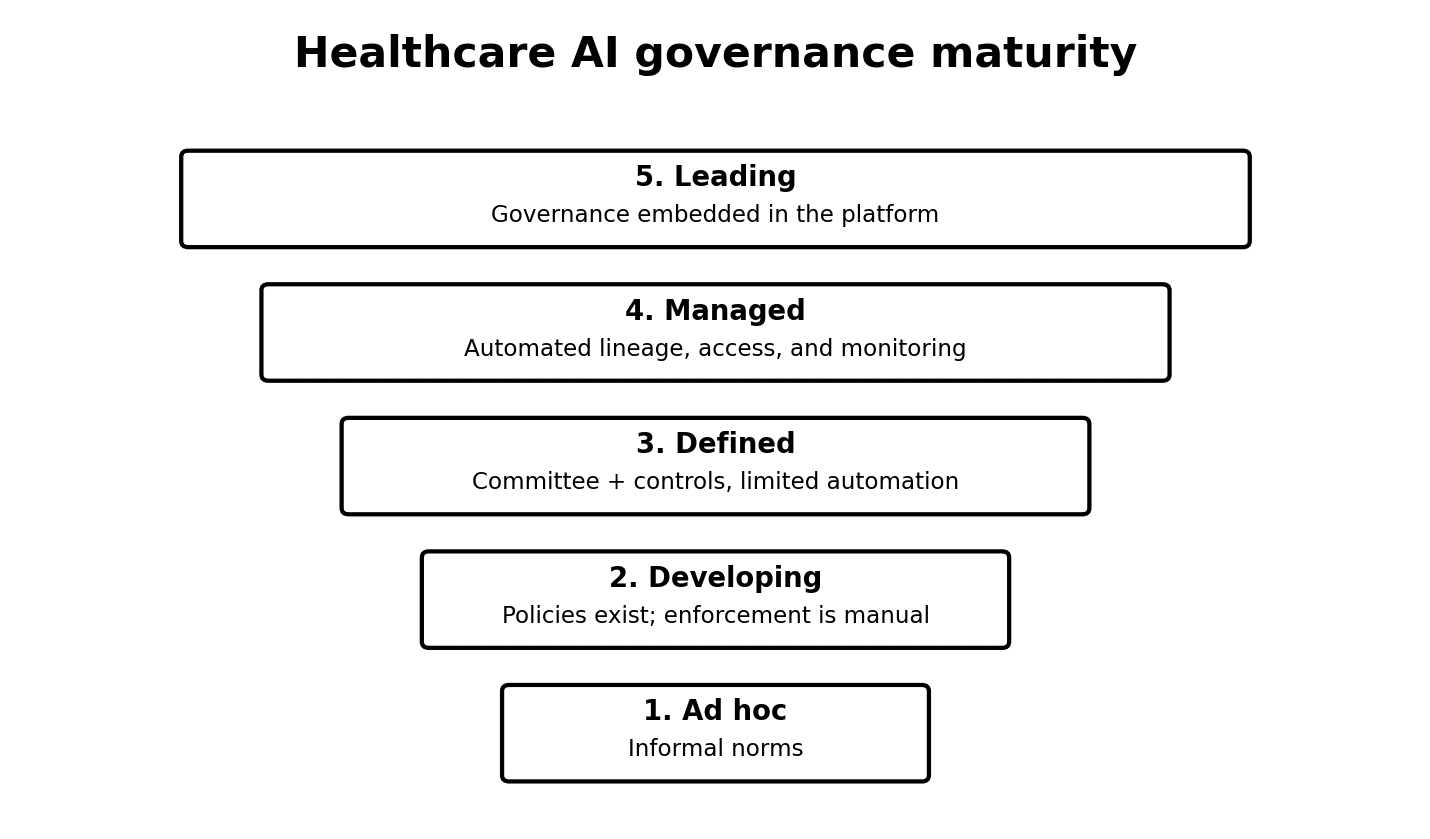
Visual: The five-level governance maturity structure described in the article.
| Level | What it looks like |
| 1. Ad hoc | Governance exists as informal norms; no consistent data or AI review process |
| 2. Developing | Policies exist on paper; enforcement is manual and inconsistent across departments |
| 3. Defined | A named governance committee reviews AI projects; lineage and access controls exist but aren’t automated |
| 4. Managed | Governance is enforced through infrastructure — automated lineage, consistent access policy across environments, measured outcomes |
| 5. Leading | Governance is invisible to users because it’s built into the platform; new AI use cases can be evaluated and approved in weeks |
Most health systems reporting the “delayed six or more projects” pattern in the Cloudera research are sitting at Level 2 or 3. They have policies and a committee, but enforcement depends on people remembering to follow a process rather than infrastructure that makes the wrong path unavailable. The jump from Level 3 to Level 4 is the architecture work this article describes.
Pro tip on governance structure: Guidance published by Censinet in 2026 on healthcare AI governance emphasizes that an effective review committee brings together legal, compliance, IT, privacy, clinical leadership, and operations, with clear decision rights at each stage of the AI lifecycle. Governance also has to show up as a repeatable, auditable workflow rather than living in a policy PDF or committee charter that nobody references day to day. If your AI review process depends on a document nobody has opened since it was written, that is a Level 2 symptom, not a Level 4 one.
A 7-point healthcare AI architecture audit
Most guidance on this topic stops at “modernize your data foundation.” Here is a concrete self-assessment. Score each item honestly; anything below five clear yeses means your next AI project is likely to join the 95%.
1. Can you enforce one governance policy across every environment? Use one policy layer that applies identical access rules whether a workload runs on-prem, in a private cloud, or in a public region. Per-environment governance guarantees drift and makes audits unwinnable.
2. Can workloads execute against data in place? Every avoidable PHI copy is a new risk surface and a new cost line. Moving compute to data instead of data to compute solves a compliance problem and a budget problem simultaneously. This directly addresses the 84% reporting rising infrastructure costs.
3. Is lineage automatic and system-level? Provenance tracking maintained by hand in a spreadsheet is out of date within a quarter and worthless in an audit. Lineage must be infrastructure, not documentation.
4. Is unstructured data inside the governed perimeter? If notes and images live outside it, the highest-value use cases can stay blocked indefinitely. A practical first step is to run a discovery pass to locate where PHI-bearing unstructured data actually lives before writing a single governance policy for it. Data governance guidance from security vendor Concentric AI frames this correctly: you cannot govern or protect what you have not first located and classified.
5. Can you measure per-workload cost before scaling? The 84% cost-increase figure exists because organizations discovered the real number after committing. Instrument during the pilot.
6. Can you produce a clinical outcome feedback loop? If you cannot continuously show clinicians the tool’s measured effect, expect the Duke adoption-decay pattern.
7. Can you run a workload where the data must legally stay? Multi-jurisdiction operations cannot centralize for convenience. The architecture has to accommodate residency constraints, not fight them.
Pro tip for using this audit: Run it with the actual governance committee in the room, including legal, compliance, IT, privacy, and a clinical lead, rather than having IT answer it alone. A “yes” that only IT believes is true is a Level 2 answer wearing a Level 4 costume.
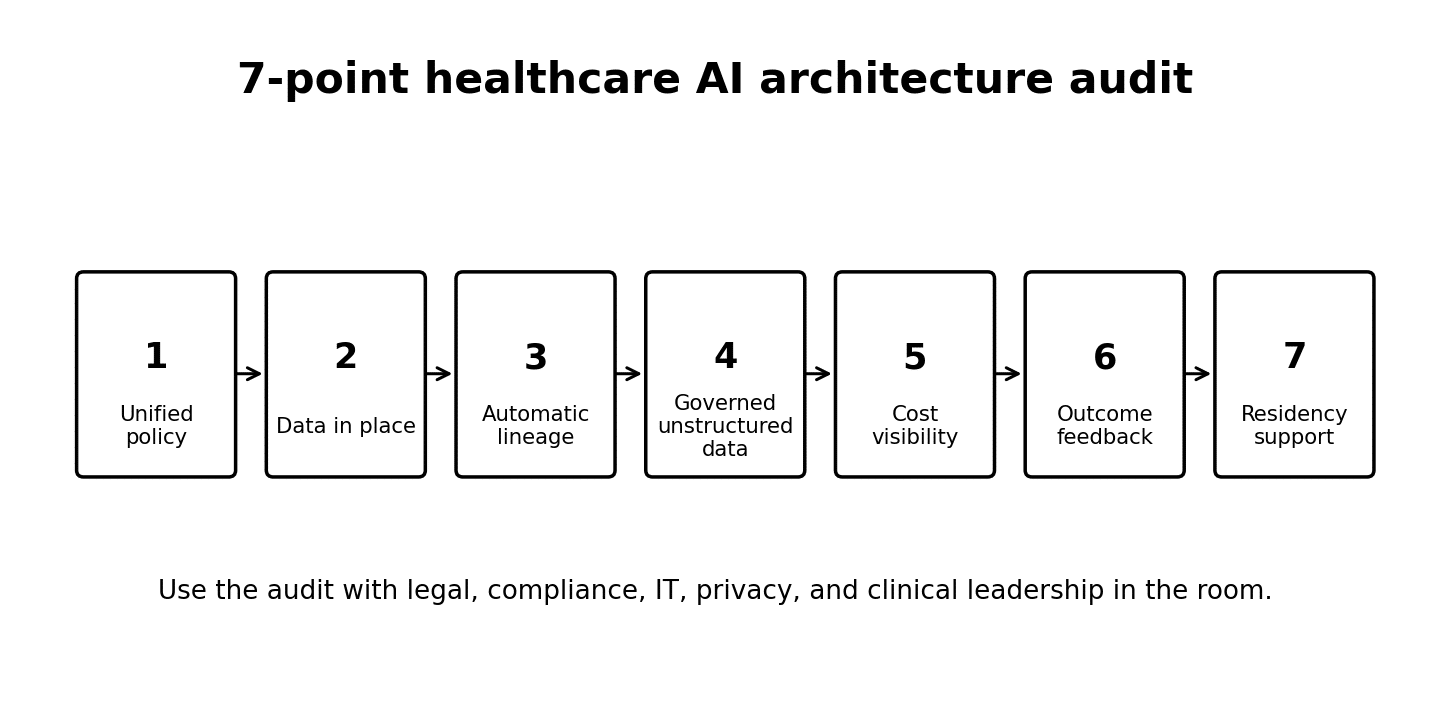
Visual: The seven checks in the healthcare AI architecture audit.
Read the vendor research critically
Fairness requires naming this: most of the numbers above come from research commissioned by a data platform company whose conclusion is that organizations need better data platforms. That is a real conflict of interest, and readers should weigh it accordingly.
Two things make the findings worth taking seriously anyway. First, they are corroborated by independent sources, including ONC interoperability data, IBM’s breach economics, HSCC governance guidance, and Duke adoption research, all of which point in the same direction from outside the vendor’s incentive structure. Second, the pattern matches what anyone who has watched an AI pilot die in a compliance review already knows.
Treat the specific percentages as directional, while recognizing that the broader pattern is well established.
What this means for health IT leaders
The organizations pulling ahead in 2026 are not necessarily the ones with better models. Model capability is broadly commoditized, and many organizations have access to comparable systems. The differentiator is the ability to evaluate and approve a new use case in weeks rather than routing it to a governance committee that meets monthly.
That gap could widen because the use cases with genuine clinical and financial value all require exactly what legacy architectures cannot provide: governed access to sensitive, unstructured, distributed data with lineage intact.
The 95% who delayed projects were not necessarily being timid. Many were being appropriately careful with data that deserves care. The mistake is treating that caution as a permanent ceiling rather than as an architecture problem with an architecture solution.
Frequently asked questions
Why are enterprises canceling AI projects in 2026?
Primarily data readiness, not model performance. Cloudera’s 2026 survey of 1,500 architects and infrastructure leads found that 95% delayed or canceled AI initiatives over the prior year because of data governance, compliance, or regulatory challenges, with 55% affecting more than six projects.
What percentage of companies need to rebuild their data architecture for AI?
72% of surveyed organizations said their current architecture requires a significant overhaul to meet future AI requirements, and 75% had already made moderate or significant changes to storage and architecture practices.
How ready is enterprise data for AI?
Only 7% of organizations surveyed for Cloudera by Harvard Business Review Analytic Services said their data was completely ready for AI adoption; 27% said it was not very or not at all ready.
Does AI increase infrastructure costs?
For most organizations, yes. Eighty-four percent of respondents reported that AI workloads increased infrastructure costs, largely because of moving, duplicating, and governing data across environments.
Why is healthcare AI harder than enterprise AI generally?
Healthcare combines strict data-handling regulation, a high proportion of valuable unstructured data, incomplete interoperability, and frequent residency constraints. Each complicates architecture independently; together, they compound.
Can healthcare organizations see where their data is?
Mostly yes. Eighty-seven percent of healthcare respondents in Cloudera’s Data Readiness Index 2026 report visibility into where their data resides. The gap is between visibility and usability: they can locate data, but they still cannot reliably integrate, govern, and operationalize it at AI scale.
What is “the great AI re-architecture”?
Cloudera’s term for the enterprise shift away from legacy analytics-era data architectures toward hybrid environments that apply consistent governance and let AI workloads run wherever the data resides.
Should healthcare data be moved to public cloud for AI?
Not wholesale. Consolidating large volumes of regulated healthcare data into a single public cloud is often impractical, costly, and difficult to govern. The prevailing recommendation is hybrid: bring AI to governed data across data centers, clouds, and edge rather than centralizing everything.
Leave a Reply