

Executive boardrooms face an unprecedented operational paradox as artificial intelligence and AI deployment spread across enterprises and operational functions. Empirical field research highlights the gap between enterprise AI, successful AI pilot programs, and measurable financial returns.
The MIT initiative cited by Pepper Foster Consulting highlights challenges in financial performance, business transformation, and AI adoption. Leaders must connect enterprise technology, operational efficiency, business operations, and organizational change to achieve meaningful digital transformation.
Effective AI implementation requires strategic leadership, a competitive advantage, and business innovation. By aligning enterprise automation and an AI-driven business with business productivity, business outcomes, return on investment, ROI measurement, and AI success metrics, leaders can improve enterprise performance.
Smart technology adoption connects AI investment with financial value and business growth. Through market competition analysis, leaders can address operational challenges and AI implementation challenges while reducing pilot program failure through enterprise strategy, business intelligence, and executive decision-making guided by data-driven leadership.
The breakdown rarely stems from deficient algorithms
Deficient algorithms are not always the main problem. An executive execution disconnect occurs when conversational interfaces operate in isolated silos without improving underlying business systems, workflows, or governance models, increasing the risk of AI implementation failure.
A strong enterprise AI strategy closes the AI execution gap through executive leadership, strategic alignment, business process redesign, and workflow optimization. Connected enterprise systems, fewer organizational silos, and better AI integration improve business process automation and operational workflows.
Organizations can combine AI-powered interfaces, conversational AI, generative AI, and AI tools with reliable enterprise infrastructure and business technology. A clear digital transformation strategy, supported by AI governance, corporate governance, operational governance, and technology integration, strengthens implementation.
Leaders should address AI adoption barriers through a practical implementation strategy and executive oversight. Business process improvement, cross-functional collaboration, and organizational alignment support better enterprise architecture, system integration, and scalable AI solutions.
With process optimization and an effective AI deployment strategy, businesses can strengthen strategic execution and enterprise-wide AI adoption. Leadership accountability, AI performance management, and operational effectiveness help guide workflow redesign, business system modernization, and organizational efficiency.
A strong technology strategy connects AI-enabled operations with digital business systems and continuous executive decision-making. This approach supports enterprise innovation while keeping AI projects focused on practical business needs.
Bridging this divide is the defining leadership mandate of this decade
The leadership mandate requires executive leadership, senior executives, C-suite officers, and department heads to follow an actionable playbook. A clear high-level strategy, proven leadership use cases, enterprise-grade risk governance, and measurable hard metrics connect AI initiatives with financial return on investment and ROI.
Strong strategic leadership and AI leadership help business leaders apply AI-driven decision-making within a practical business strategy. An enterprise AI strategy, supported by a leadership framework, executive action plan, and strategic planning, helps prioritize valuable AI use cases and business applications of AI.
Successful enterprise AI adoption depends on risk management, AI risk governance, and enterprise risk management. Leaders must also address AI compliance, responsible AI, AI ethics, data governance, regulatory compliance, cybersecurity, and operational risk.
Clear financial metrics and key performance indicators (KPIs) help track measurable business outcomes, ROI tracking, and performance measurement. Monitoring business value, cost optimization, revenue growth, and productivity gains reveals how AI improves operational efficiency and strategic alignment.
When linked to business transformation, these efforts strengthen enterprise innovation, business resilience, and organizational agility. A focused AI investment strategy improves resource allocation, while executive accountability, an AI implementation roadmap, and scalable AI solutions support enterprise performance management.
Finally, data-driven strategy helps leaders achieve business growth and build a sustainable competitive edge. By adapting to changing customer needs and market conditions, organizations can use AI to remain relevant, efficient, and competitive.
Key Takeaways
- Executive Strategic Definition: Applying artificial intelligence at the executive level is not about line-level task execution; it is about probabilistic decision augmentation, strategic resource allocation, and continuous enterprise adaptation.
- Highest-Impact Leadership Use Cases: Dynamic scenario simulation, automated cross-departmental reporting, capital allocation modeling, and synthesized market intelligence.
- The Core Strategy Framework: Shift from opportunistic tool-testing to a four-stage execution engine: isolate high-value business bottlenecks, run tight 90-day production pilots, scale validated automation workflows, and establish adaptive oversight guardrails.
- Primary Enterprise Risks: Unchecked model hallucinations, proprietary data leakage, automated decision bias, and regulatory compliance exposure under evolving global AI mandates.
- Core ROI Equation: Transition beyond vanity productivity statistics to track decision velocity, unit economics per executive deliverable, error reduction, and operational leverage.
How to Work AI for Business Leaders?
Understanding ai for business leaders begins with dismantling the misconception that executive AI mirrors day-to-day employee adoption. Navigating this shift requires clarity on core terminology and architectural scope.
What Does “AI for Business” Actually Mean? Is This Powerful in Upcoming Time?
At its core, what is ai for business? In enterprise environments, business AI refers to the integrated deployment of machine learning algorithms, deep learning neural networks, and generative cognitive systems designed to parse massive corporate datasets, automate repeatable workflows, and optimize high-stakes decisions.
What Is Enterprise AI?
Enterprise AI is an interconnected layer of intelligent models, automated pipelines, and autonomous workflows that translates fragmented operational data into predictive forecasts and strategic actions.
Key capabilities:
- Predictive and prescriptive analytics across complex operations
- Automated cross-system execution through specialized intelligent agents
- Natural language synthesis and semantic extraction over unstructured proprietary data
Is this capability genuinely powerful in the upcoming landscape? Research published in Management Decision confirms that organizational AI capability directly mediates competitive performance by restructuring how strategic decisions are framed, stress-tested, and executed.
As market conditions fluctuate rapidly, static historical reporting is becoming obsolete. The emergent paradigm shifts enterprise infrastructure from retrospective dashboards to forward-looking, real-time recommendation engines capable of modeling market shifts before quarterly earnings capture them.
How Is AI for Leaders Different From AI for Operations Teams?
The functional gap between how executives leverage intelligent systems versus frontline operational teams lies in cognitive scope and business impact:
| Dimension | Frontline Operations Teams | Business Leadership & C-Suite |
| Primary Objective | Incremental efficiency, task speed, and workflow throughput | Asymmetric advantage, strategic direction, and capital protection |
| Work Unit | Individual tasks (drafting copy, resolving tickets, generating code) | Multi-variable decisions (M&A targeting, product bets, supply chain shifts) |
| System Interaction | Direct tool execution and prompting | System architecture oversight, automated synthesis, and policy guardrails |
| Success Metrics | Hours saved per employee, error rate reduction per ticket | Margin expansion, capital efficiency, operational leverage, and agility |
Frontline staff deploy AI to accelerate granular output. In contrast, an executive uses automated systems to simulate strategic trade-offs, cut through bureaucratic friction, and direct resources with quantified confidence intervals.
Why Should Business Leaders Prioritize AI in 2026?
The Competitive Pressure: Identifying the AI Adoption Gap in Marketing and Beyond
Across marketing, product innovation, and customer acquisition, early movers are establishing compounding advantages. In their extensive benchmarking study, Boston Consulting Group (BCG) demonstrated that enterprise AI leaders achieved 1.7x higher revenue growth, 3.6x greater total shareholder return, and 1.6x higher EBIT margins compared to market laggards.
The adoption divide is widening rapidly:
- The Synthetic Production Gap: While traditional teams spend weeks assembling quarterly creative campaigns, AI-enabled competitors orchestrate hyper-targeted personalization engines that test thousands of creative variants dynamically.
- The Feedback Compression Gap: Market insights that previously required months of agency research are now surfaced in hours by querying live customer sentiment and purchase signals.
- The Organizational Speed Gap: Companies leveraging integrated workflow platforms execute cross-functional projects without expanding headcount proportionally, permanently lowering their marginal cost of operation.
The Cost of Waiting
Delaying strategic deployment creates asymmetric downside risk. In software and platform ecosystems, network effects and automated feedback loops widen performance chasms between market participants.
Every quarter spent watching the market evolve without establishing clean internal data pipelines widens the capability deficit against rivals. Waiting does not insulate an organization from risk; it locks the enterprise into manual operational overhead while competitors automate their cost base.
Which Top AI Use Cases for Business Leadership?
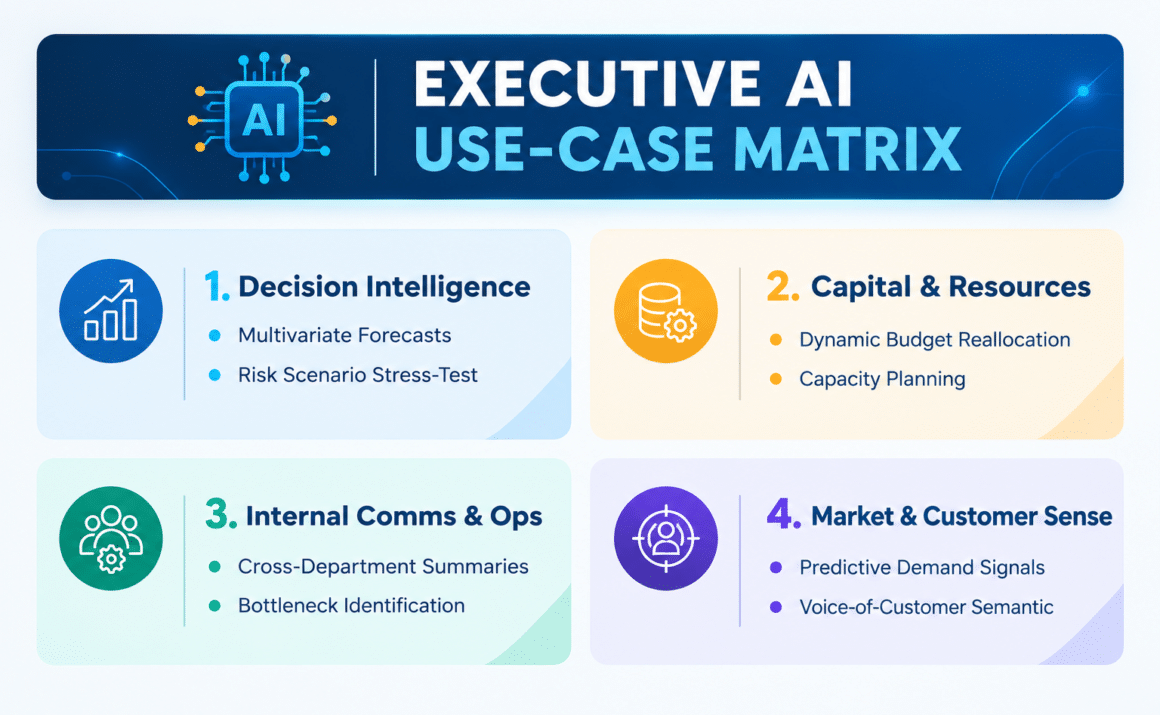
Modern executives leverage enterprise AI across distinct functional axes that touch strategic agility and organizational oversight:
Decision-Making and Forecasting
Traditional enterprise forecasting relies on static regression models that struggle with macroeconomic volatility. By contrast, contemporary decision-intelligence frameworks run multivariate scenario analyses in real time.
As outlined in research published in Administrative Sciences, integrating generative and predictive models into strategic decisions allows managers to stress-test counterfactual scenarios, such as currency fluctuations, tariff adjustments, or supply disruptions, quantifying potential risk surfaces before executing major capital expenditures.
Resource Allocation and Planning
Executive resource allocation frequently suffers from departmental bias and misaligned operational capacity. Specialized decision engines continuously ingest operational velocity, project burn rates, and margin contributions to recommend optimal capital and talent distribution across business units, preventing stranded capital in underperforming initiatives.
Internal Communication and Reporting
According to OpenAI’s State of Enterprise AI Report, enterprise users save 40–60 minutes daily when intelligent systems handle cross-functional synthesis.
For senior leaders, this capability transforms internal performance reviews. Rather than reading disjointed 60-page PDF status decks, leadership teams deploy automated workflows that cross-reference enterprise resource planning (ERP) figures, CRM data pipelines, and Jira burn-down charts to automatically flag critical blockers and timeline deviations.
Customer and Market Insights
Rather than waiting for delayed quarterly survey readouts, leaders leverage semantic clustering across millions of unstructured data points, including customer service transcripts, product usage telemetry, and public reviews, to surface emergent buying preferences or service vulnerabilities weeks before they impact renewal numbers.
AI Adoption by Leadership Function
- Chief Executive Officer (CEO): Simulating corporate strategy trade-offs, accelerating competitive counter-moves, and aligning departmental OKRs.
- Chief Financial Officer (CFO): Autonomous audit sampling, variance identification, predictive cash-flow forecasting, and pricing elasticity optimization.
- Chief Marketing Officer (CMO): Omnichannel campaign optimization, customer lifetime value modeling, and rapid brand positioning analysis.
- Chief Information Officer (CIO) / Chief Technology Officer (CTO): Standardizing secure agentic architectures, eliminating shadow IT, and auditing code infrastructure.
- Chief Operating Officer (COO): Supply chain routing resilience, cross-functional operational automation, and labor capacity load balancing.
Why Should Leaders Need to Build an AI Strategy?
Ad-hoc experiments generate fractured tool sprawl rather than organizational transformation. To build durable operational moats, leadership teams must execute a deliberate four-stage strategy.
Step 1: Start With Business Problems, Not Tools
The most frequent strategic error is procurement-led adoption: securing enterprise software licenses before identifying the core business friction requiring optimization.
A disciplined strategy begins by mapping the core economic bottlenecks of the business:
- Where are high-cost knowledge workers spending 30% of their billable week on repetitive document processing?
- Which operational workflows cause recurring customer churn or slow delivery cycles?
- Where does lack of predictive visibility result in capital write-downs?
Anchor initial investments strictly where automated processing or predictive intelligence produces a direct, measurable financial return.
Step 2: Run a Focused Pilot
Avoid ambitious, multi-year multi-department deployments during initial implementation. Select a single high-impact operational surface with measurable historical baselines and run a bounded 90-day production pilot.
At this phase, modern leaders utilize dedicated automation and orchestration platforms. For instance, Droven.io serves as a modern foundation for enterprises seeking to deploy integrated workflows without building custom machine learning pipelines from scratch.
By utilizing comprehensive orchestration engines like Droven.io, leadership teams can connect intelligent capabilities directly to underlying databases, run controlled production pilots, and rapidly benchmark execution speed against legacy manual baselines.
Step 3: Scale What Works
Once a pilot proves that an automated system reduces turnaround latency or cuts unit processing costs by 40% or more, establish standard operational playbooks to scale the workflow horizontally.
Transitioning from simple point-solution scripts to coordinated multi-system execution requires deploying autonomous agents. Integrating specialized, modular AI agents for business allows enterprises to automate complex workflows across finance, customer success, and operations while maintaining systematic human-in-the-loop oversight.
Step 4: Build Governance Early
Never treat safety, compliance, and risk controls as retrospective add-ons. Establish an enterprise AI Council composed of cross-functional representatives from Legal, IT, Security, and Executive Management before scaling tools into customer-facing operations.
As highlighted by security and operational analysts at CIO.com, effective governance cannot be a static corporate policy document gathering dust; it must function as an adaptive operational framework with active guardrails embedded directly into everyday software workflows.
Role of Generative AI Play for Leaders
Generative AI marks a fundamental platform shift: moving software from structured numerical calculations to nuanced semantic and textual reasoning.
For an in-depth operational breakdown of foundational architectures, explore our pillar guide to Generative AI for Business, which details technical architectures, API integration requirements, and core enterprise infrastructure models.
From an executive vantage point, these capabilities automate complex synthesis, strategic briefing generation, and stakeholder communications. Senior executives can review our tactical manual on Generative AI for business leaders to study practical C-suite prompt design, decision augmentation frameworks, and organizational change management models.
Finally, generative interfaces are radically transforming analytical architectures. Rather than relying on rigid, pre-built SQL dashboards, leaders can query structured data lakes using conversational language. Learn how to transform internal telemetry into real-time competitive intelligence through our deep dive on Generative AI for Business Intelligence.
What Are the Risks and Governance Considerations?
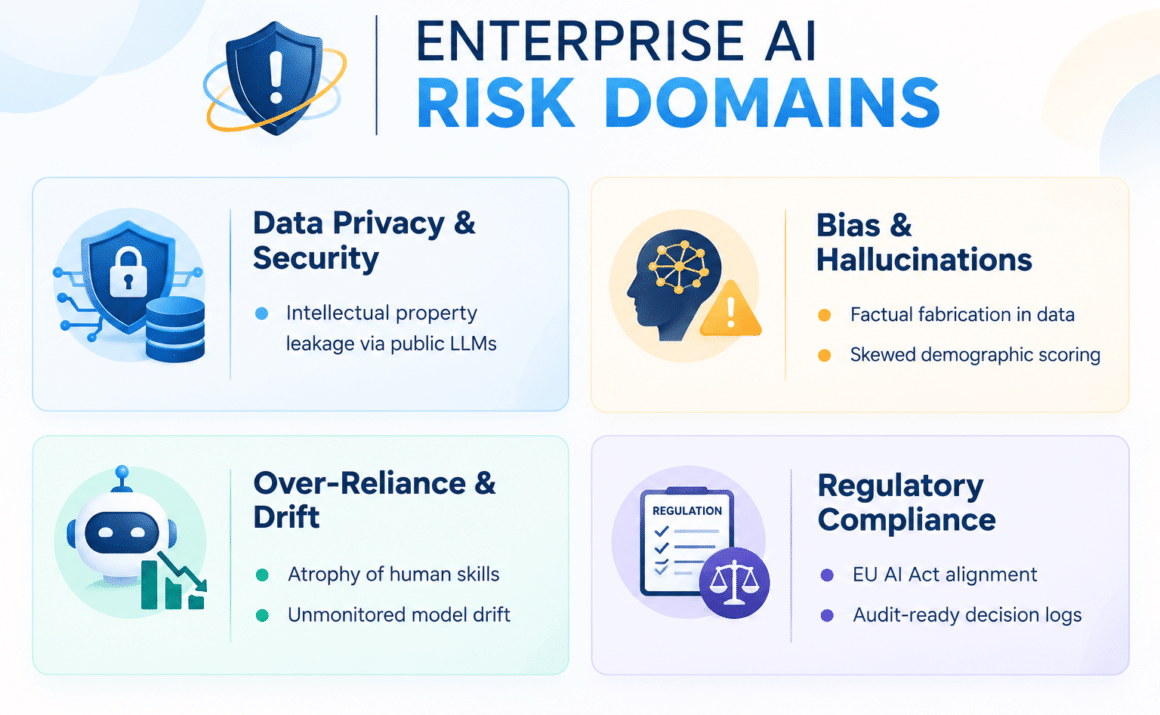
Unmanaged adoption exposes organizations to operational, reputational, and balance-sheet liabilities. Enterprise strategy must anticipate four major risk domains:
Data Privacy and Security
Sending unencrypted corporate balance sheets, proprietary intellectual property, or confidential customer records to public, consumer-grade foundation models risks catastrophic confidentiality breaches. Enterprise leaders must mandate zero-data-retention agreements, enterprise virtual private cloud (VPC) deployments, and private enterprise instances.
Bias and Hallucinated Outputs
Foundational models generate text based on probabilistic token prediction rather than deterministic fact verification. A study published in EDPACS underscores that unmitigated AI hallucinations present severe corporate audit and accountability risks. If left unverified by human specialists, hallucinated outputs in corporate filings, strategic forecasts, or customer-facing documentation can lead to substantial financial misstatements and liability.
Over-Reliance on AI Recommendations
Automated decision support must augment human judgment, not replace critical evaluation. When leadership teams outsource fundamental strategic choices to algorithmic models without scrutinizing underlying assumptions, datasets, and baseline constraints, organizations become brittle and susceptible to strategic blind spots.
Regulatory and Compliance Exposure
Global regulatory bodies are intensifying enforcement. Frameworks like the European Union’s AI Act impose stringent compliance mandates, conformity assessments, and continuous audit trails on high-risk algorithmic applications, including automated recruitment, credit scoring, and critical operational infrastructure. Corporate leaders must implement explainable, audit-ready AI workflows to protect against steep regulatory penalties.
How Do Leading Companies Measure AI ROI?
Navigating past superficial productivity metrics requires leaders to evaluate AI initiatives using standard financial metrics and rigorous balance-sheet accountability.
Metrics That Matter
- Cycle Time Reduction: Measuring the elapsed time from operational trigger to final business deliverable (e.g., accelerating contract negotiation and redlining from 14 days down to 6 hours).
- Unit Cost per Deliverable: Calculating the fully loaded cost of generating marketing campaigns, auditing legal agreements, or resolving complex customer inquiries before and after automation.
- Decision Velocity & Accuracy: Tracking latency in discovering operational deviations, alongside post-implementation forecast accuracy versus historical baselines.
- Revenue per Employee (Operational Leverage): The capacity to double corporate transaction volume or market expansion without a matching, linear expansion in administrative overhead.
Common Measurement Mistakes
- Measuring Activity Instead of Output: Tracking total conversational queries or token consumption instead of documented process improvements or direct cost reductions.
- Premature Evaluation Cycles: Expecting systemic bottom-line transformation within 30 days of deploying pilots, ignoring the organizational learning curve required to integrate tools into daily workflows.
- Failing to Account for Fully Loaded Infrastructure Costs: Calculating ROI solely against software subscription fees while overlooking internal engineering hours, API usage spikes, model fine-tuning expenses, and continuous compliance reviews.
ROI Metrics Tracked by Leading Companies
| Metric Category | Primary KPI | Practical Measurement Method | Target Baseline |
| Operational Efficiency | Hours saved per week | Automated time-tracking across repetitive back-office tasks | 20–35% reduction in administrative time |
| Financial Yield | Cost per task reduction | Total loaded labor cost divided by completed output units | 40–60% reduction in processing cost |
| Quality & Accuracy | Error & revision rate | Percentage of automated drafts requiring extensive human correction | < 5% critical defect rate |
| Speed to Market | Campaign/feature cycle time | Calendar days from initial concept approval to customer launch | 2x to 3x cycle time acceleration |
Frequently Asked Questions
What is AI for business leaders in simple terms?
AI for business leaders refers to using intelligent software, machine learning, and generative models to make faster, data-backed decisions, eliminate operational bottlenecks, and build scalable competitive advantages, rather than using consumer tools for basic task automation.
Do business leaders need technical skills to use AI?
No. Business leaders do not need to write machine learning code, build algorithms, or manage data science infrastructure. However, they do need strong conceptual understanding: recognizing what AI can and cannot solve, defining strict operational problems, identifying process bottlenecks, and establishing risk guardrails across the organization.
Where should a leader start with AI in a small company?
Small business leaders should avoid broad, company-wide rollouts. Begin by identifying your highest-cost, most repetitive operational bottleneck—such as customer onboarding communications, invoice reconciliation, or lead qualification. Deploy a focused, pre-built workflow solution on that specific friction point for 60 to 90 days to prove measurable efficiency before expanding.
What are the biggest risks of AI for leadership decisions?
The primary leadership risks include algorithmic hallucinations (acting on factually fabricated data), proprietary information leaks from using insecure public tools, algorithmic bias leading to poor talent or financial decisions, and severe compliance liabilities under emerging global AI regulations.
How long before AI shows measurable ROI?
Targeted operational pilots focused on automating narrow, highly manual tasks (like document processing or first-line customer support) often deliver demonstrable efficiency gains within 60 to 90 days. Comprehensive enterprise transformations that influence revenue growth and cross-departmental operations typically require 6 to 12 months of structured workflow integration.
Conclusion
The divide between AI experiments and real business results
An enduring competitive edge comes from using artificial intelligence to solve real problems, not simply following trends. AI for business leaders should focus on helping business leaders move beyond superficial novelty and turn AI deployments into practical solutions for quantifiable business bottlenecks.
A clear business strategy connects strategic execution with AI implementation and AI adoption. A strong enterprise AI strategy prioritizes business process optimization, identifies operational bottlenecks, and addresses everyday business challenges. By tracking performance metrics, key performance indicators, and KPIs, leaders can evaluate whether AI delivers genuine improvements.
Turning business priorities into measurable progress
Successful AI adoption depends on data-driven decision-making and reliable business intelligence. Companies should focus on operational efficiency, continuous process improvement, and workflow optimization to increase business productivity and strengthen enterprise performance. These efforts can improve financial performance, support revenue growth, and protect profit margins through effective cost optimization.
From an operational perspective, I would assess AI projects by comparing their results with existing processes before expanding them. Measuring return on investment and ROI measurement against measurable business outcomes helps leaders understand whether a tool saves time, reduces costs, or improves customer service. This practical approach connects strategic leadership and executive decision-making with real business needs.
Building trust through responsible AI implementation
Long-term progress requires digital transformation, enterprise innovation, and dependable technology integration. Strong AI governance, accurate data quality, effective data security, and proactive risk management help organizations use AI responsibly. These foundations improve operational performance and support business scalability as adoption expands.
Leaders must also consider sustainable growth, market adaptability, and market competition when planning AI investments. As changing market conditions reshape customer expectations, business resilience and organizational agility become essential. Careful resource allocation ensures that funding and talent support projects with measurable value.
Regular performance measurement helps demonstrate business value, identify opportunities for margin improvement, and strengthen operational effectiveness. By treating AI as part of a broader enterprise transformation, rather than an isolated technology project, organizations can achieve AI-driven business growth and support long-term business success.
Leave a Reply